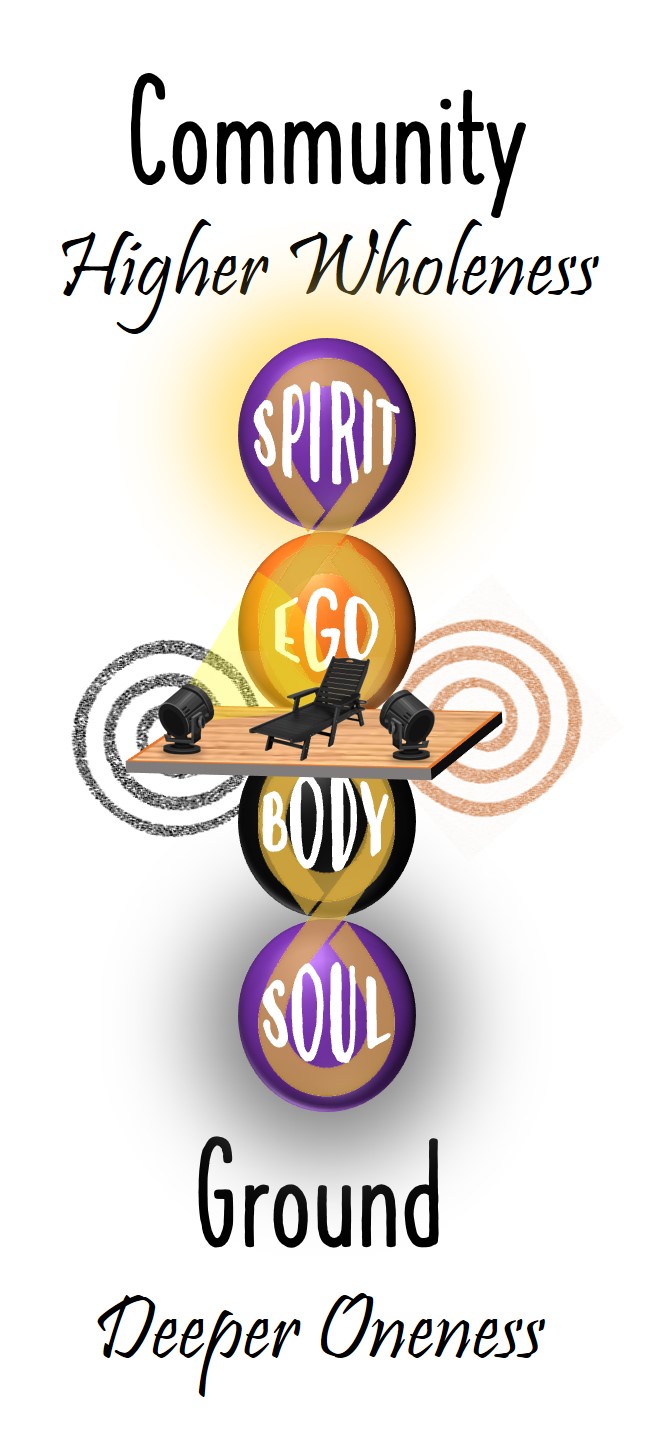
Are you familiar with that metaphor of arranging deckchairs on the Titanic?
The message is that while we are busy piddling around with minor things, the really Big Thing needing our attention is going down – taking us and our trivial fixations with it.
Besides being a helpful call-back to our priorities in business, family, and personal life, the Deckchairs metaphor also has relevance to life in general – to what the philosophers have long referred to as human existence.
As we get distracted into the egosomatic disorders of everyday life – attachments, obsessions, anxiety and depression – our existence is slowly but surely sliding beneath the waves.
Now, it could very well be that our fixation on trivia is providing a kind of therapeutic distraction keeping us from having to look at or think about what’s really going on.
Perhaps if we didn’t have these “everyday disorders” to preoccupy us, the full-frontal realization of our mortality would drive us bat-shit crazy.
The wisest of our species throughout history have called attention to what really matters.
They don’t typically stand there scolding us, reprimanding our stupidity for getting stressed and exhausted over mental minutiae. Instead, the best and brightest of these prophets, sages, and mystics appeal to something inside us that already knows the truth. We just need the courage to fully accept it.
And what is that truth? Actually, there are three.
The first truth identifies human nature as harboring a potential we can barely even imagine. In the illustration above, this potential is depicted by the four centers of consciousness arranged on a vertical axis: Spirit, Ego, Body and Soul. Considered through a developmental and evolutionary lens, however, the progression from potential-to-fulfillment would have us read them organically from bottom to top: Soul, Body, Ego and Spirit.
Circulating through these four centers is the current of human consciousness itself, shown in the illustration as an undulating golden colored wave, amplifying or attenuating as it weaves along the circuit. As it ascends or descends from one center and frequency to another, distinct dimensions of experience are activated.
The full activation and “four-dimensional” experience brings our human potential to fulfillment – which is the fully self-actualized state identified in the first truth.
The Soul centers consciousness in deeper oneness, in what the worldwide wisdom tradition known as the Perennial Philosophy or Sophia Perennis names the Ground of Being. Asian schools of Sophia Perennis use the term nondual, or “One without a second,” in speaking of the Ground – which, technically speaking, cannot be named or known because it is not a thing. This is what they mean in calling it Nothing (no thing), or ultimate reality without qualities (nirguna Brahman).
As we proceed with our ascent of the axis to the center next in line, we are expanding the frame on our understanding of human potential, as we are also introduced to (or reminded of) a second truth.
The Body centers consciousness in the sensory-physical realm, linking it to the great Web of Life upon which our survival depends. It hosts our sensations of pleasure and pain, excitement and fatigue, joy and grief, hunger and thirst.
And, as is true of all other living and sentient organisms on Earth, our Body is mortal and will eventually succumb to entropy, exhaustion, and death.
There are numerous traditions both inside and outside Sophia Perennis that teach the separation of Body and Soul, where the Soul, conceived as the essential Self, is immortal and moves on after the Body dies – either to another Body, to some disembodied state in paradise, or to full union with the Absolute or Supreme Reality.
Other traditions of Sophia Perennis, however, regard the Body and Soul as complementary centers of consciousness, like Yin and Yang of the Tao, with the Body engaging with our experience as an animal (of the species Homo sapiens) in the Web of Life, and the Soul releasing inwardly to the Ground of Being. One doesn’t contain or inhabit the other; at death, their shared circuit of energy breaks and the light goes out.
This notion of the extinction of consciousness at death is a much-debated topic, as you might imagine. Anecdotal reports of near-death and postmortem experiences, adventures in reincarnation, or visions of the afterlife are especially appealing when we find our own mortal extinction difficult to accept.
The part of us that struggles most vigorously with the prospect, however, is neither the Body nor the Soul, but the Ego center of consciousness.
Ego (from Latin for the first-person “I”) is where consciousness becomes self-conscious for the first time. It serves as a kind of converter bridge in the cross-over of consciousness from the animal Body and onto the performance stages of society. Out on stage, Ego “personates” (i.e., puts on and acts out) various identities (personas) associated with distinct social theaters (e.g., family, school, workplace, teams, clubs, and social media groups).
On stage is where Ego, as actor, feels most at home, and paradoxically where it can feel out of place and utterly alone.
The function of Ego as a converter bridge not only directs our attention to the social performance stage. It also exposes a functional dependency of Ego on the primal energy of the Body. Without the upward feed of the Body’s lifeforce, the Ego would have nothing to work with; indeed, it could not even exist.
This dependency on the Body, while rather obvious and straightforward as we consider it objectively, becomes a source of profound anxiety for the Ego as it learns the news that the Body will one day die.
With both endpoints of the converter bridge clearly in view now, we can anticipate how Ego’s anxiety over going down with the Body might translate into mental states and social behaviors on stage that would interfere with the role-plays of identity, recognition, and belonging.
Insecurity motivates attachment, which drives ambitions that in turn lock our mind inside rigid convictions, blinding us to the Reality around us. We obsess over arranging deckchairs, as the Titanic is going down.
And this is the third truth. What we so quickly and chronically get worked up about is not even real.
Our neurotic attachment and worry give it the weight of something substantial, but that’s all it is: a feeling entwined to a fantasy.
The “salvation call” of Sophia Perennis, if – IF – we are in a mental state where we can even hear it, invites us to break free from our convictions, surrender our ambitions, drop our attachments, and sink through our insecurity to the Ground within. As we find the courage, grace, and faith to do this – which according to the Chinese tradition of Sophia Perennis is really a non-doing (wu wei) – the full channel of human consciousness is allowed to complete its circuit.
At the center of Spirit, consciousness opens at last to the higher wholeness of Community. Our experience is of a dynamic participation in the All that is One. Community itself is a dynamic term, qualitatively different from a mere collection or assembly of things. Its analog at the largest conceivable scale is the Universe, referring to all things “turning as One” (uni-verse).
In order to arrive at this level of Unity, consciousness has to detach and transcend Ego’s personal orientation and concerns, for a new and higher – transpersonal – perspective on existence.
Suddenly we wake up to realize that our obsession over deckchairs is itself a kind of spiritual tragedy of the greatest magnitude.
 Tracts of Revolution