It’s weird to think that humans are still on the journey to actualizing our full potential as a species. All other species, as far as we can tell, reach fulfillment in each generation, where the young develop to maturity as the adults nurture them along. For the most part, genetic codes and the drives of instinct ensure that each individual actualizes the inner aim (entelechy) of the species.
We use the designation “endangered” for those species that are at risk of falling into extinction due to climate conditions, loss of habitat, over-predation by other species, critically low birth rates, or devastating disease. The human species is certainly not endangered in any of those senses, although our own ambition, ingenuity, and ignórance (willful ignorance) will someday – probably sooner than later – bring about our self-destruction, if we continue on our present course.
But modern humans are indeed an endangered species, if we think of it in terms of falling short of our ideal, of what a human being is intended by nature to become. To understand the dynamic in play, we need to acknowledge a factor in human evolution and development that isn’t present in other species: self-consciousness and its executive center of identity named ego (Latin for “I”).
This wildcard factor of ego is both the leading indicator of human progress and the “Achilles’ heel” that threatens to bring us down.
Joseph Campbell discovered “the hero with a thousand faces” throughout world mythology, and he believed that the Hero’s Journey is really what the stories are all about. Whether a particular myth is focused on the adventures of a hero or heroine, or instead throws the horizon of wonder out to the larger cosmos and the acts of a god, its power as story is anchored to the center of self-conscious experience in the mythmaker and his or her audience.
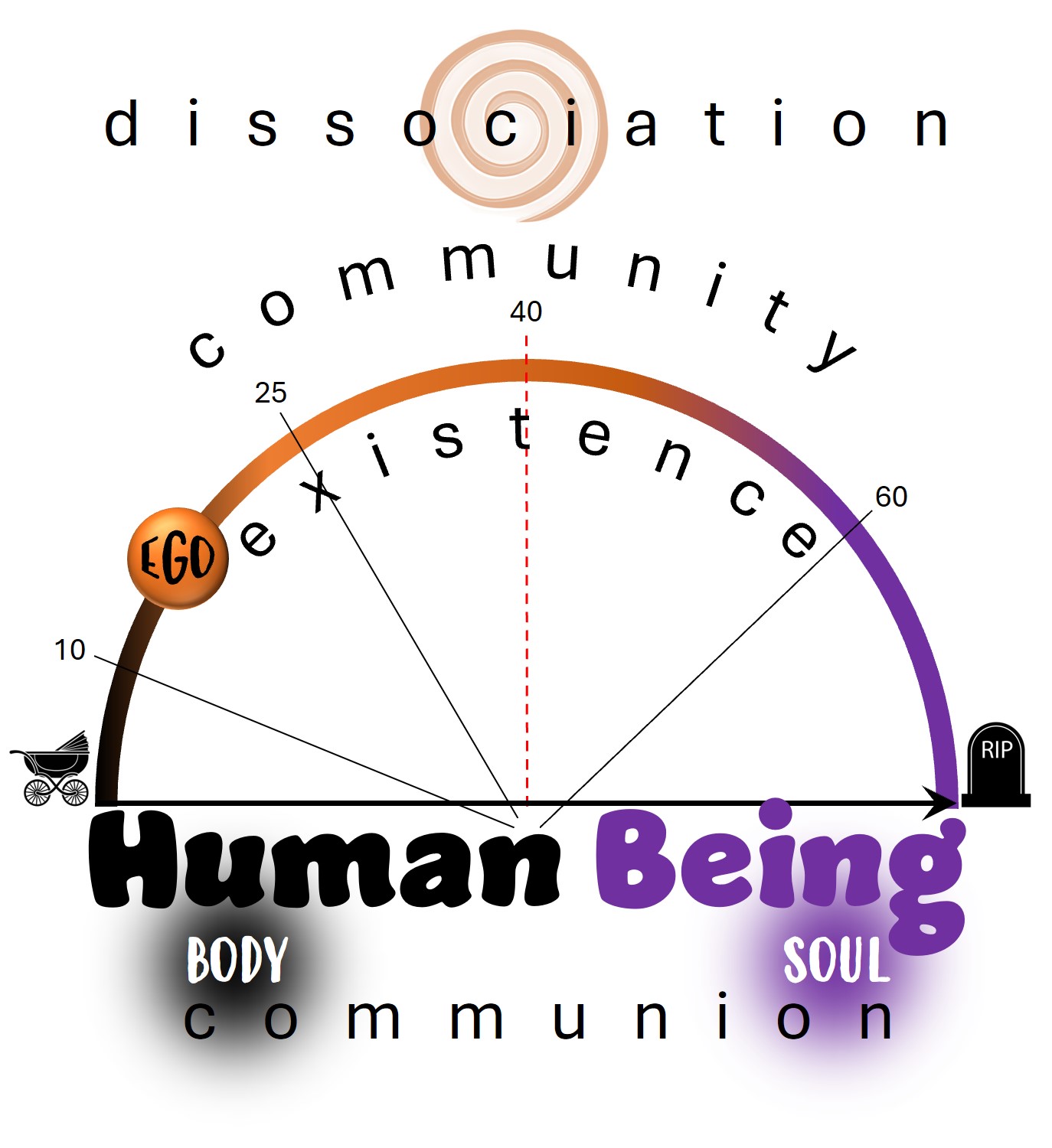
We might think of the mythos or plotline of these stories as tapestry upon a frame constructed of the dynamic principles and dimensions of our self-conscious (egocentric) experience. The illustration above diagrams these dimensions on a vertical axis with the terms communion, existence, community, and dissociation. Moving across horizontally is the arc of development that tracks the progress and perils of ego’s heroic adventure.*
Communion refers to the deeper oneness of body and soul, the outward and inward orientations, respectively, of our animate consciousness as human beings. “Human” and “being” distinguish these complementary orientations in a way that can also be read as the human (manifestation of) being.
Human, then, names our animal nature and species as homo sapiens: the genotype, biology, physiology and neuroanatomy that identify us among the classifications across the web of life on Earth. This is the expression or manifestation of being that we recognize as ourselves.
Being refers to the generative power-to-be evident (or manifested) in the astonishing diversity of beings: molecular beings, rock beings, tree beings, bird beings, cloud beings, star beings … and human beings. Each of us is a communion of human and being, outer and inner, body and soul.
It is out of this communion that ego begins its journey into existence, referring literally to the act or process of “stepping or standing out” (ex + sistere) from the deeper oneness of body and soul. To be conscious of ourselves, a portion of consciousness must detach from communion in order to secure an external vantage-point from which these can be appropriated as “my body” and “my soul” – that is, as belonging to “me,” the self-conscious “I” (ego).
But of course, our essential nature as human manifestations of being is not property of the ego, which makes its claim delusional and its perception of the body and soul as separate an illusion.
This is where many religions veer away from the perennial wisdom tradition (Sophia Perennis), affirming and embellishing on ego’s delusion of independence and ownership rather than acknowledging the illusion of separateness – from the position of egoic consciousness – and then finding ways to “part the veil” to Reality and the liberated life.
Typically, a religion will either condemn the ego as something to be subdued, or glorify it as something to be saved. According to Sophia Perennis, whether the strategy involves renouncing or rescuing the ego, our focus (on the ego) is fundamentally misplaced. The assumption of its substantiality comes along with the certainty of its separate existence – which is the illusion we need to get beyond.
Developmentally speaking, ego formation is intended for the purpose of facilitating human progress into community. This refers not only to our relationships with other ego-centered persons, but with all of life and the even the cosmos itself, at which scale is named the Universe (“turning as one”). While communion is the deeper (undifferentiated) oneness of body and soul in the grounding mystery of Being, community is the higher (diversified) wholeness of all things, together as One.
The long process of individual development and of our evolution as a species is about focusing consciousness through the lens of ego where the Universe becomes aware of itself in, and as, us. Through us, the Universe feels what it is to be human, sees itself through human eyes, and is able to act in the freedom of will and with the bigger picture in mind.
Sophia Perennis (often personified in the myths as a woman) stands at the threshold with the veil of illusion pulled aside, inviting us to the Infinite Life outside our cocoon.
Our experience of, and inclusion within, the higher wholeness of community and the greater Universe can be overwhelming if we happen to be bound by insecurity to our ego and desperately trying to hold our own. The orange-colored spiral in the illustration above depicts this tightening loop of anxiety, frustration, and depression that pulls the ego off its intended course and into a state of dissociation.
In religious mythology, this state or condition of dissociation is represented metaphorically in the experiences of possession (loss of self), captivity (loss of freedom), and exile (loss of belonging).
It is not our destiny as humans to succumb to dissociation from Reality. And yet, the centripetal pull of dissociation into more extreme states of anxiety, frustration, and depression works to separate us not just from Reality, but also from our own common sense. We are in danger of reaching a point where nothing makes sense, nothing really matters, and any hope of getting out and finding our way back is utterly lost.
We might as well take each other and everything else down with us.
*The diagram above charts a typical human lifespan, advancing through the life stages of the Child (birth to age 10), Youth (ages 11-25 years), Adult (ages 26-60), and Elder (age 61 to death). At midlife (around age 40), an individual will typically undergo what’s known as a “midlife crisis,” where the dynamics of existence and dissociation can throw the ego’s hero journey profoundly – in some cases catastrophically – off course.
 Tracts of Revolution