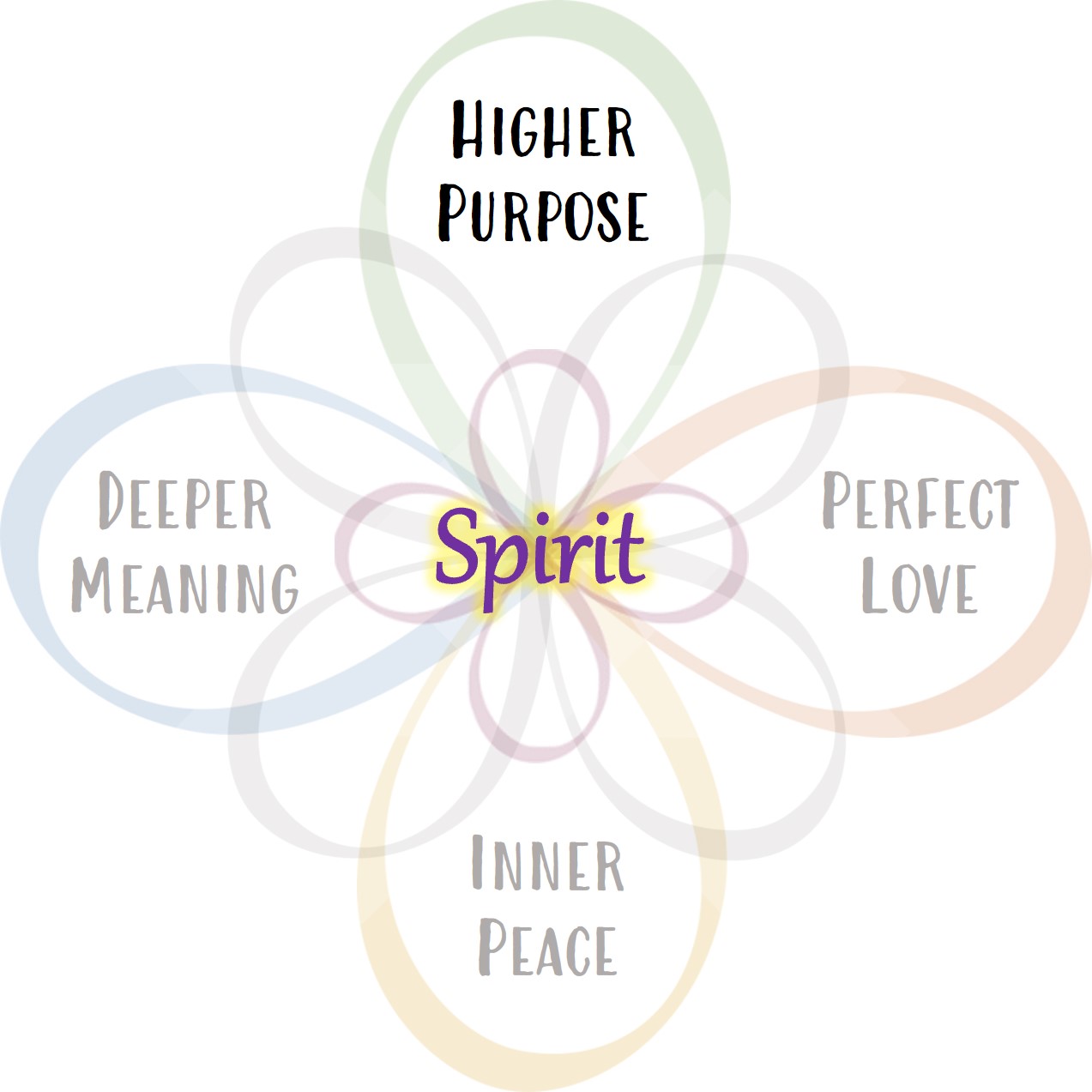
One of the deep and universal principles of spiritual wisdom states that the wellbeing and fulfillment we seek in life cannot, and will never, be found in this world. Many religions misunderstand this principle to mean that our salvation lies elsewhere or awaits us in the afterlife, in another world beyond this one.
Any interpretation that advises us to renounce the world and fix our devotion on supernatural, heavenly, or otherworldly things is a contradiction of wisdom’s vision. Tragically, although most religions originated in this vision and its profound insights into the nature of Reality and our human promise, too many of them, and too soon, lost its compass and got distracted from the path into deathtraps of dogmatism, conviction, and power politics.
The grand vision of the spiritual wisdom tradition, better known as the Perennial Philosophy or Sophia Perennis, honors the human spirit in each of us as a force of creative freedom that seeks, desires, and drives our quest for wellbeing and fulfillment. This quest is frequently frustrated by the lesser ambitions of our ego, the unique and separate “I” who is busy being somebody special and chasing after happiness.
Spiritual wisdom invites and challenges us neither to renounce nor glorify the ego, but to use its ‘lens of intention’ to live with a higher purpose in mind.
The Path of Higher Purpose
With the breakthrough to ego consciousness, our human species entered the illusion of having a separate existence from the rest of Reality. Paradoxically, the transformation that pitched our self-conscious identity into exile also, and in the same moment, opened new frontiers of spiritual awareness and experience.
Whereas the historical religions have tended to dwell on the “fall” and “loss” associated with our exile, the spiritual wisdom tradition has been focused on exploring these frontiers for a fuller understanding of human potential, wellbeing, and fulfillment.
From the perspective of Sophia Perennis, the achievement of ego consciousness and an ego-based identity is not yet the high point in human evolution, but neither was it an existential tragedy as many religions claim.
A self-conscious personal identity (ego) is only the penultimate step or stage on the way to what we are intended to become.
If regarded as the ultimate step, the one completing our long story of human evolution, then it certainly is a type of tragedy. The consequent experiences of alienation, estrangement, loneliness, anxiety and depression cannot be the “higher purpose” of our existence.
But again, in contrast to much popular religious doctrine, our salvation – literally our healing and wholeness – will not come by either extinguishing or “saving” the ego, but rather by stepping through its illusion of a separate existence into harmony and communion with What Is.
In the language of Western psychology, we are here talking about the faculty of Will. Both human evolution and child development take a decisive turn – the “breakthrough” mentioned above – as an individual learns to restrain the animal impulses and primal instincts of the body, in the interest (or “for the purpose”) of adjusting behavior to the social landscape of tribal expectations and its moral frame.
By sublimating these “wild” (i.e., natural) impulses into a “domesticated” and well-mannered way of behaving, the Will facilitates a critical crossover of the threshold leading to a uniquely human experience.
The tribe directs this crossover/breakthrough by providing various roles that serve to define and shape how a social insider ought to behave. Over time, with consistent practice and discipline, consciousness becomes self-conscious as this or that social role: “I am” the role, the one who others expect to see, who has a place on the stage and a part to play.
The actor (ego) identifies with its persona (or personifies the role) and therewith becomes somebody special.
To make an important distinction, while the emergence of ego (self-) consciousness marks a shift from compulsive urgency in the body to moral intention on the performance stage of society, this is not yet the “higher purpose” contemplated in the spiritual wisdom tradition. With Nietzsche, we might say that moral intention (and morality generally) is still a captive of tribal values and its command structure of obedience.
Higher purpose involves a second-order liberation, a “transvaluation of values” by an intention toward creative authority, genuine community, and human fulfillment.
Through this lens, the vision and teachings of mystics and prophets the world over and throughout history can be seen as a single, transcendent ideal of the human spirit. It also helps us better understand the inevitable resistance and condemnation from the side of those tribal moralities and their imperative of obedience.
To wake up from the consensus trance, stepping through the veil of personal identity and into the higher wholeness of unitive consciousness – well, that can’t be tolerated on the performance stage where everyone is expected to stick to the script. This is why many of our spiritually brighter lights in history have so often suffered persecution and death at the hands of “righteous” true believers. The sentence is characteristically carried out “in god’s name.”
Having some sense of this human aspiration for higher purpose, the religions will typically personify it as “god’s plan for my life,” requiring a believer’s complete obedient submission. When it is “god’s will” that devotees behave and believe according to some orthodox prescription, it should be clear that we are still stuck in the role-play – however holy and righteous it happens to be.
Because the religions in modern times devolved into protected memberships of moral obedience, the human longing for higher purpose has gotten hamstrung and pinned down by something that ought to have been preparing it to fly.
Other Posts in This Series:
 Tracts of Revolution
3 thoughts on “Our Longing for Higher Purpose”