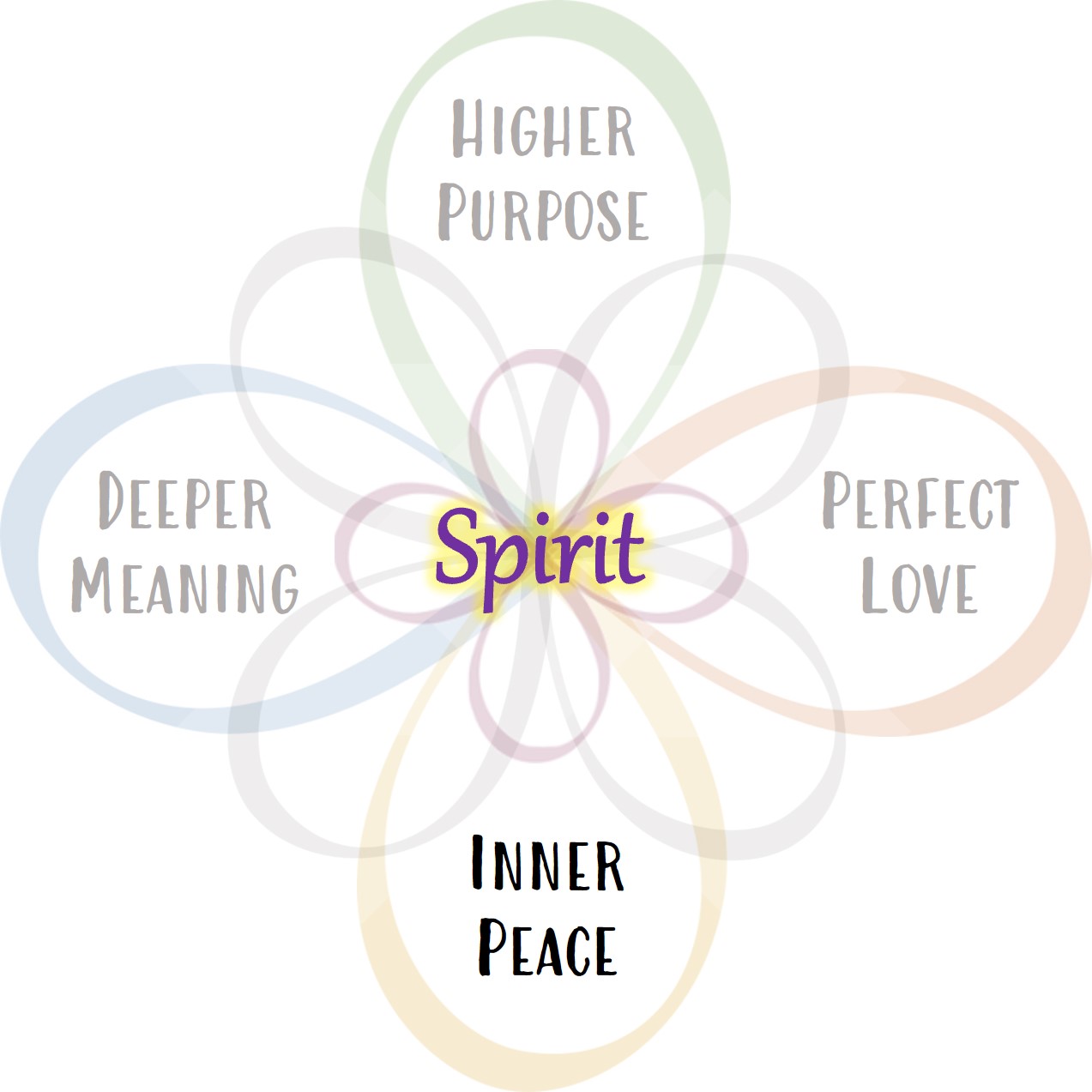
One of the deep and universal principles of spiritual wisdom states that the wellbeing and fulfillment we seek in life cannot, and will never, be found in this world. Many religions misunderstand this principle to mean that our salvation lies elsewhere or awaits us in the afterlife, in another world beyond this one.
Any interpretation that advises us to renounce the world and fix our devotion on supernatural, heavenly, or otherworldly things is a contradiction of wisdom’s vision. Tragically, although most religions originated in this vision and its profound insights into the nature of Reality and our human promise, too many of them, and too soon, lost its compass and got distracted from the path into deathtraps of dogmatism, conviction, and power politics.
The grand vision of the spiritual wisdom tradition, better known as the Perennial Philosophy or Sophia Perennis, honors the human spirit in each of us as a force of creative freedom that seeks, desires, and drives our quest for wellbeing and fulfillment. This quest is frequently frustrated by the lesser ambitions of our ego, the unique and separate “I” who is busy being somebody special and chasing after happiness.
Spiritual wisdom invites and challenges us neither to renounce nor glorify the ego, but to go beneath the ground and beyond the horizon of its merely personal concerns.
The Path to Inner Peace
Wisdom tells us that “world peace” will only come about as each of us cultivates inner peace, a peace deep within ourselves, in the very ground of our being. To the degree we are not at peace within ourselves, we will be at odds and in conflict with others and the world around us. Like all other animals with nervous systems, humans perceive and react to what’s going on “out there” through the filter of how we are “in here.”
The inward path and spiritual aspiration for inner peace have been significantly distorted and misunderstood in religion’s slide down the slippery slope into metaphysics – or we should more accurately say, into metaphysical realism. Metaphysics generally refers to the study of essence (being) and the inner nature of Nature, Life, and Mind. Being, or be-ing (the power-to-be), manifests itself in each existing thing and throughout the manifold order of beings.
Metaphysical realism assumes, and often dogmatically claims, that this “ground of being” is something else, something other and apart from the realm of individual beings. Erase every being in existence and the ground of being would continue to exist. It’s an easy equation to make at this point, where this separately existing Ground is the god of religion who created all things in the Beginning, called together his elect and established the one true religion, and will rescue his devout believers to heaven in the End.
A danger in all mythologies of this sort lies in our susceptibility to become blind to their metaphorical depth and transparency and take them literally as referring to actual things, to real metaphysical entities: metaphysical realism.
When it speaks of the ground of being, or the grounding mystery within, Sophia Perennis stays true to experience and counsels the meditator to let consciousness descend past the zone of ego commentary, fantasy, and conviction. For it is only from ego’s position of separate identity that anything is regarded as something else and essentially other, which predisposes ego to regard the grounding mystery also as other, as some thing to think about, talk about, and keep at a distance.
The path to inner peace is an interior descent of the sentient life and animate consciousness of our body. It requires that we allow awareness to drop away from ego, from its managed identity and personal world at the surface.
Because the process is not about ego’s descent of the grounding mystery of being, but rather a release and surrender of all the attachments, personas, ambitions, beliefs, and thoughts that compress to form its self-conscious center of identity, the inward path to peace is “egolytic,” making progress by gradually dissolving the ego (the suffix -lysis means to loosen and disintegrate).
The human spirit is not an antagonist of the body. Metaphysical realism has promoted the familiar dualism of an immortal (pure) soul temporarily trapped inside a mortal (corrupt) body, but the spiritual wisdom traditions don’t agree. Beneath the separate center of who we are (ego and identity) is the grounding mystery of what we are: a human manifestation of being.
With each deeper stage in our descent of the Ground, the “container” of awareness doesn’t get smaller but instead expands to larger and larger (ad infinitum) horizons.
A supreme paradox of inner peace is that, as our human spirit descends by the inner path to the grounding mystery deep within, rather than retreating into an isolated solitude, consciousness opens out to a boundless presence where All is One.
Now the creative work toward world peace has a chance.
Other Posts in This Series:
 Tracts of Revolution
3 thoughts on “Our Longing for Inner Peace”