In this blog, I am intent on doing my part toward correcting and clarifying the conversation around religion. Instead of identifying it with one or another of its historical examples, I’ve urged the importance of defining religion itself as a system of symbols, stories, sacraments and practices that link us back (Latin religare) to the universe, to one another, and to our own grounded existence in the here and now.
The need for such reconnection is brought about by the formation of a separate center of personal identity, our ego, which generates the delusion of standing apart (me) from everything else (not-me). Because the construction of identity is a necessary stage in the full development of a human being, we need a way back to Reality where everything is connected and All is One.
Religion, of whatever brand, is our Ariadne’s Thread out of the winding labyrinth that lures us deeper into the illusion of who we think we are.
So, however we come back to Reality, that is our religion.
A much more serious problem arises, however, when we forget or lose sight of the fact that our pursuit of identity takes us away from what’s real. In today’s conventional religions of theism, where a devotee’s focus is on the projected image of a deity regarded as separate and supreme, our lost connection with Reality has taken a pathological turn into conviction, extremism, and violence.
True believers are excluding, persecuting, and killing “in god’s name” those who don’t agree or live differently.
If believers could understand that their concept of God (i.e., their god) is only that – a construct of the mythopoetic imagination engaged with the ultimate mysteries of Being, Life, and Love – they might look through it to what’s real and really see that All is One.
But they can’t. The conspiracy of mythological (or biblical) literalism and dogmatic orthodoxy has imprisoned them inside a collective delusion, persuaded that their final salvation depends on what they believe and getting it right.
Coming back for the larger vision shows very clearly that “salvation” will not be found in separating ourselves from others, gaining liberation from our bodies and escaping to another world when we die.
Ironically, we need to be liberated from the religion organized on our pursuit of becoming somebody. Having become somebody, we should be able to get over ourselves – but we’re stuck.
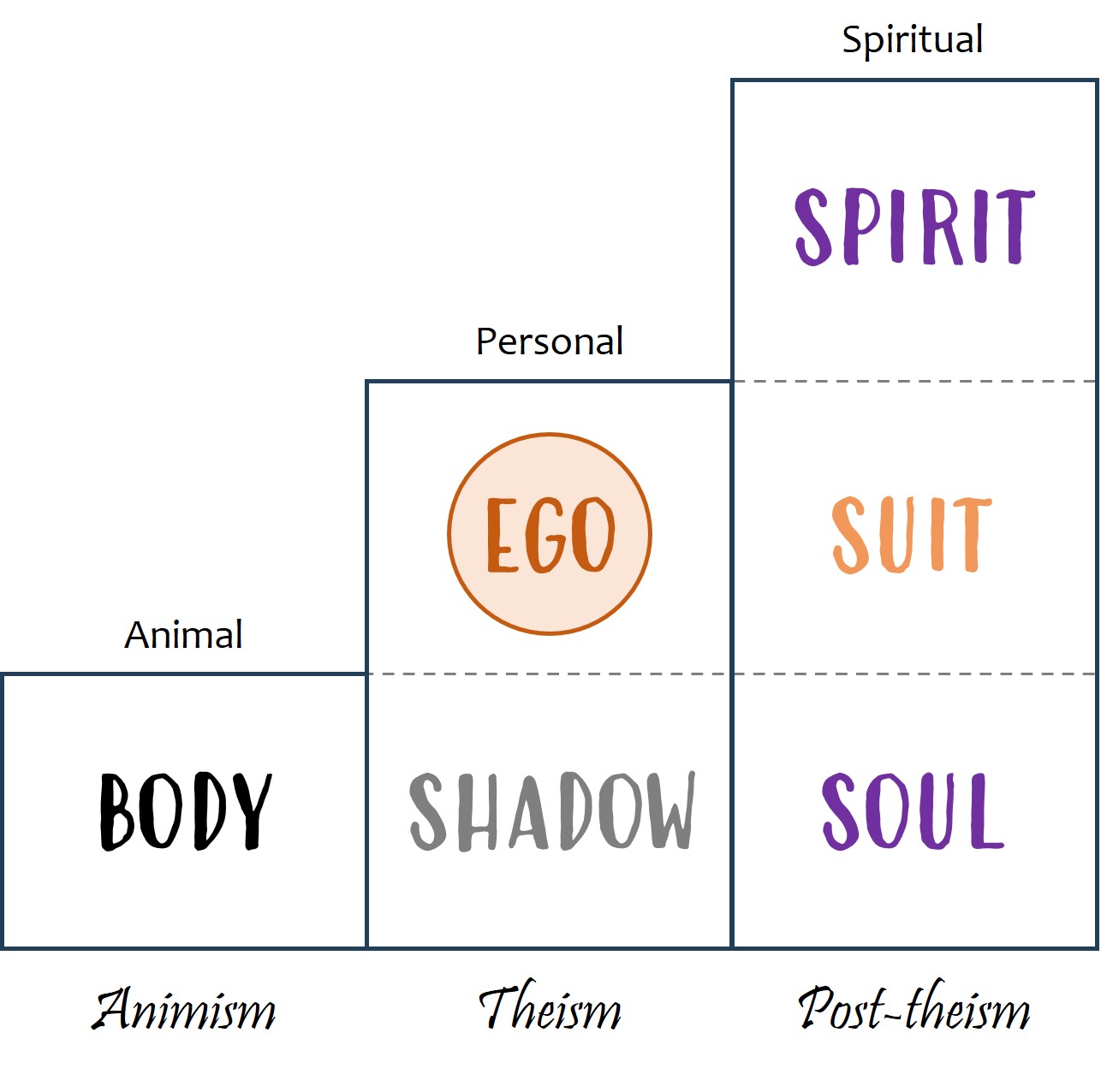
The diagram above distinguishes the major types of religion and critical stages of human psychospiritual development. Perhaps a view of the larger scheme can help us appreciate the significant contribution of theism, as it also provides context for the positive anticipation of what theism can break open into – not a breakdown to atheism but the breakthrough of post-theism.
With each major type or stage, the language of religion necessarily shifts, and with it our basic way of engaging with Reality. These shifts are indicated in the columns moving to the right and upwards with time.
Animism is the religion of Nature and our body-centered experience. There is no separate personal identity as yet, no “I” (ego) that stands apart in its own locus of control, agency, and will. Consciousness is fully embodied, immersed in the instincts and urgencies of animal life, attuned to the rhythms and cycles of natural time. Life is the animating force in our body, evident as well in the myriad living beings all around us.
Essential to the religion of animism, as well as to its associated stage of early childhood development, is this sympathetic intelligence of Life pulsing through it all.
The work of religion at this stage is to guide and facilitate our reverent participation in the great Communion of Life. Absent the self-conscious orientation of ego, our response is more spontaneous, playful, and imaginative.
By late childhood or early adolescence, consciousness has taken a position of reflexive self-awareness, from a center of personal identity that puts on and acts out a variety of roles (or suits) connecting us to age-relevant role plays of our tribe.
From the location of ego in my diagram, we curate a wardrobe of suits (identities) that secure the social acceptance we need and the approval we crave. This simultaneously produces a shadow in our personality consisting of natural talents and animal propensities that others – especially our taller powers – can neither accept (repression) nor expect from us (ignórance).
The obsession with becoming somebody and finding social validation of our identity, but also with pushing the deviant or unacceptable parts of our nature down and out of sight, helps explain many common features of theism.
- An authoritative higher power in the deity, whose mediators (priests, pastors, and other clerics) supervise the faith, service, and sacrifice of believers.
- A moral frame in which a “good person” and “right action” are defined in terms of what pleases god and fulfills god’s commands.
- The righteous exemplar of a saving advocate (Savior) who stands in opposition to a diabolical adversary (Satan) that threatens to pull devotees into the darkness of sin and damnation.
- A fixed and absolute boundary separating insiders from outsiders, the “chosen few” from atheists and other enemies of god.
Such is the framework basic to theistic religion. The names and characters are different from one religion and culture zone to the next, but the elements of this framework are universal across all its forms.
Now, if our development gets stuck here, held captive by dogmatic convictions and protected memberships, the consequence will be spiritual frustration. This will either turn inward to become depression, or outward as fanatical aggression against everyone and everything that is not on our side.
The sharp rise in religiously motivated violence and terrorism, while not intrinsic to theism per se but a sure sign of its corruption, is why many today are choosing for atheism.
We need to understand that identity is not essence. Who we are striving to become is a superficial pursuit when compared to what we already are and have been from the beginning: a human being, or a human manifestation of being.
When our animal nature is honored and respected for what it brings to the construction project of identity, the shadow will be less repressed and volatile, making it much easier when the time comes to detach from our roles and from the ego as actor.
The time comes as the cocoon of theism begins to wear thin and Reality starts shining through.
A post-theistic spirituality returns to the body as our grounding mystery, dropping away from the attachments and social agreements of identity and into the mystical depths of Soul. The shadow we so feared is now befriended as Keeper of our Light (“light bearer” = Lucifer in Christian mythology). Actually it was fear that created our shadow in the first place, and can still bring it back from time to time.
And because we can hold on loosely to who we are, we are free also to join ourselves to the great Community of Spirit – the higher wholeness that, paradoxically, our ego prevented us to some extent from seeing but now provides an intentional way in.
 Tracts of Revolution