It is common to assume that since religion is such a complicated topic, spirituality should be as well. The sprawling variety of deities, symbols, rituals, sanctuaries, traditions, customs and beliefs across the landscape and history of world religions might lead one to conclude that the spiritual life of humans is just as variegated.
We may be surprised to learn, however, that just as the vegetal lifeforce is embodied and expressed across countless species of trees, so is the spiritual life of humans essentially the same beneath the diverse cultural expressions of religion.
Indeed, while the “horizontal” study of comparative religion is of critical importance to our knowledge and appreciation of its many types and examples, a more “vertical” exploration of religion’s inner life is necessary in order to assess its authenticity, alignment with, and fidelity to spiritual experience – in a word, its truth.
In this blog, spirituality or the spiritual life is not defined in metaphysical, esoteric, supernatural, or paranormal terms. Its concern is not with metaphysical beings (e.g., gods or spirits), supernatural realms (e.g., heaven, hell, and astral planes), or paranormal experiences (e.g., prophecy, clairvoyance, near-death or out-of-body).
Instead, human spiritual life has to do with our capacity and ongoing quest for peace, love, and joy.
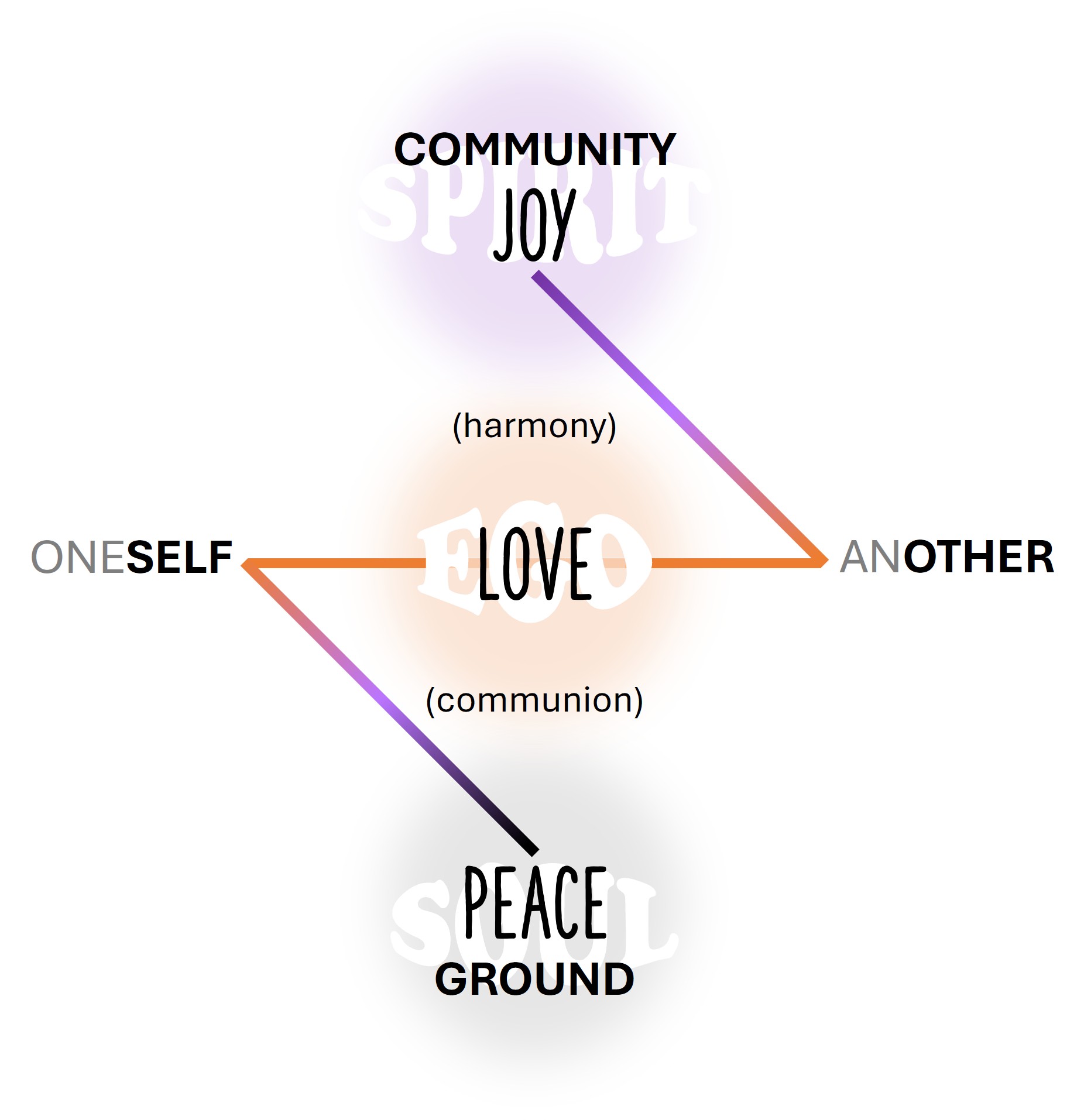
Each of these experiences engages a distinct dimension of consciousness, which can be summarized as “within me” (peace), “between me and you” (love), and “all of us together” (joy). Furthermore, each of these dimensions corresponds to its own mental location of awareness, thus:
- peace and the ground within: Soul
- love and the bond between us: Ego
- joy in the belonging of community: Spirit
It’s important to clarify that these “mental locations of awareness” are not regarded here as entities inhabiting the human being, as in the classical dualism of a supernatural soul inside a mortal body. The primary term in each case is consciousness, with awareness (or consciousness-of) engaging with a distinct dimension of experience: (1) within oneself, (2) between oneself and another, or (3) at the transpersonal level where All is One.
The glossary of spirituality is remarkably simple as compared to the symbology, iconography, mythology, theology and liturgy of religion.
Peace, love, and joy are, therefore, the special concerns and aspirations of human spiritual life, of a universal human spirituality. Wherever on Earth and whenever in history humans have lived, they have been intensely interested in these states of awareness and their associated frequencies of experience.
As the conditions of life change across environmental circumstances, individual development, and cultural evolution, our need for inner peace, interpersonal love, and communal joy is a human constant.
In the time remaining, we will take a tour of the diagram above illustrating these three dimensions of spiritual life, starting at the center from the mental location of Ego. We begin here rather than at the bottom (Soul) or top (Spirit) because of the fact that spiritual awakening is initially a personal process, which is to say it occurs and unfolds relative to the vantage-point of a first-person self-conscious (i.e., egoic) experience.
Already, and with some confidence, we can say that our human attainment of inner peace and communal joy is conditioned by our success through infancy and early childhood – that is, during the critical period of ego formation – in the interpersonal realm of love.
Nurtured under the provident care of taller powers who love us, our focus of interest can find a healthy balance between our own needs and those of others (the poles of oneself and another). In this balance of love, consciousness can rest in the deeper intuition of communion, as it engages more actively (and outwardly) in the social dynamics of harmony – “doing our part” as a way of living out the deeper oneness we share.
The attainment to love as communion gradually enables consciousness to release the mental location of Ego, by degrees or all at once, and descend to deeper registers of the Soul and its ground. Peace refers to the experience of a quiet inner composure, centered at a place deep within ourselves where the first-person vantage-point (Ego = “I”) – monitoring, managing, narrating, and evaluating our progress – finally dissolves into a pure present awareness.
We can think of inner peace as the realization of deeper oneness, originally confirmed in our early experiences of communion with another, now opening even deeper to the grounding mystery of Being itself.
Returning to the middle position of Ego in our diagrammatic glossary of the spiritual life, we see how the healthy balance of love between oneself and another also opens upward through the harmonious engagement in relationship and into the transpersonal realm of our life in community.
It should be clear that by community we are indicating something more – a qualitative step beyond – the group dynamics of ordinary social interaction. Our clue to the difference lies in the concept of harmony, which requires and builds on the reciprocal exchange across individual differences, each making its unique contribution to the shared symphony of the whole. Community is this higher wholeness, not merely the sum total of parts but a synergistic (1+1=3) transformation beyond their mere “group effect.”
Also from the glossary of spirituality we find the idea of ecstasy, of “standing outside (or stepping beyond) oneself,” which is an apt depiction of this transpersonal leap beyond Ego.
Communal joy should not be reduced to the more conventional notions of happiness, giddiness, delight or elation. Joy can be a very serious thing, particularly as we attend to the commitments of genuine community and take responsibility for our part in its symphony. Whereas happiness is generally derived from our circumstances and life conditions, joy in this sense is an outflow of Spirit from deeper in the matrix of love and our sense of belonging to something greater than (the sum total of) ourselves.
The metaphor of Spirit, referring to the invisible force of “breath” and “wind” which fills, refreshes, and flows through us – or else tatters and tears us apart should we resist or try to contain it – is fair warning against any romantic expectations that genuine community will be easy sailing.
If we truly desire joy – and the long tradition of wisdom spirituality insists that it is a higher human need – then we will have to do our part.
 Tracts of Revolution
Your mother was the essence of this!!!