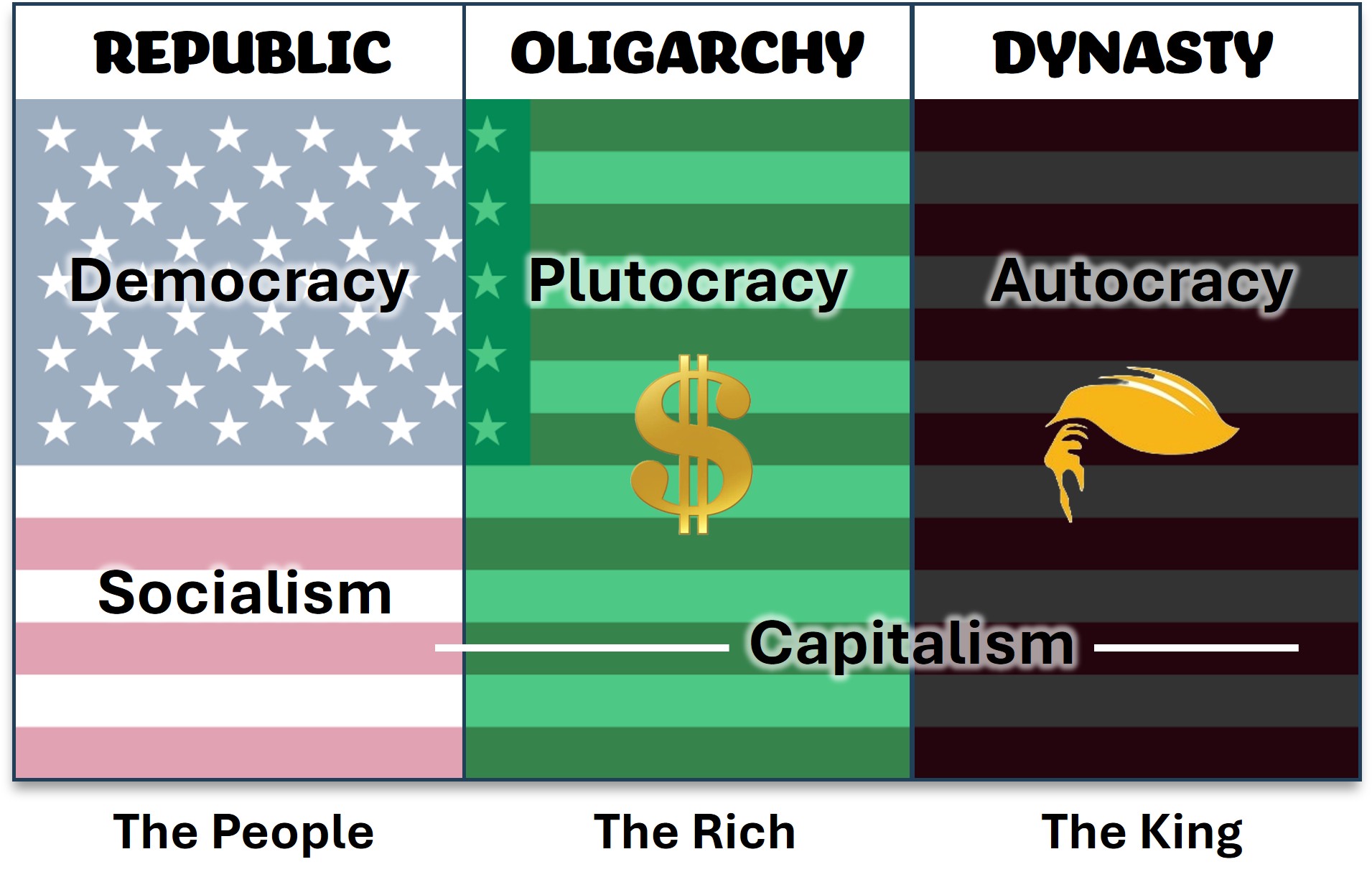
Back during Donald Trump’s first run for the White House, I pointed out something that no one else seemed to notice – at least I didn’t hear them talking about it. My observation was that, while Trump was running as the Republican candidate, he wasn’t (and still isn’t) a Republican. I predicted, in fact, that if Trump won the presidency and took control, the Republican party would soon lose its soul.
And I was right.
How did I know? Simple. Donald Trump has never really cared much for politics. As a businessman, he always preferred to bend the political frame around his financial ambitions – or break it, if necessary. His interest in becoming president was also more financial than political. He would run as a Republican, but only ostensibly, or In Name Only.
Trump’s true “party” was Capitalist. His rise from inherited wealth, through bankruptcy, and into borrowed wealth again made him something of an avatar of American capitalism.
I dedicated a few posts during that period to exploring what I saw as the inherent contradiction in American democracy, between its democratic political model and its capitalist economic model.
Although these two had co-evolved in American history, their relationship was conflicted from the beginning. Whereas democracy gives priority to “the people” and their commonwealth, capitalism favors the individual over community – civil liberties, self-reliance, private property, and the pursuit of happiness through material prosperity. Tax-funded social welfare versus low taxes and everybody-for-himself.
The archetypal contest of American history has been cooperation versus competition, a “more perfect union” versus the American Dream.
Democratic values centered in equality and justice for all argue for a big-enough government and a sufficiently large safety net. Capitalist values centered in individual freedom prefer a small government that pretty much leaves its people alone and stays out of their way.
So it happened. Upon being elected president, Donald Trump proceeded to neuter the Republican party and crush its soul. Following his nearly successful attempt to overthrow the American government on January 6, 2021, Trump went back underground to revise his strategy and gather a new cadre of stooges and sycophants who would swear their undying loyalty to him and his cause.
Re-elected, astonishingly, in 2024, Trump and his wrecking crew went to work demolishing long-standing traditions, sacred customs, and historical institutions undergirding American democracy. At this writing, the U.S. economy is stressed and faltering, as Trump and his club of oligarchs rake in millions.
As President Trump maneuvers the Court to grant him supreme power and near-absolute immunity, he is ever more quickly pulling American democracy toward autocracy.
If Trump’s professional resume is any guide, those oligarchs gathered around him now will eventually be thwarted and thrown aside on his way to monarchy. As his minions, they have been recruited for their lack of morals and specialized ignorance, to carry out his commands without hesitation or moral afterthought.
His end-game vision is an American dynasty, with a gilded ballroom and the “Trump” brand perched on the Capitol dome in place of the Statue of Freedom.
Very recently, however, with the election of New York City mayor Zohran Mamdani, something in the American body politic seems to be shifting. Maybe it’s the American Spirit waking up after many decades of denying the contradiction in its fusion of democracy and capitalism. Mamdani aligns with democratic socialism, which true-believing capitalists like Trump try to spin as communism – or they genuinely just don’t understand the difference.
For Mamdani and others who lean democratic socialist (or identify as Social Democrats), an economic model that focuses on social equality and communal wellbeing is the Yang to democracy’s Yin.
Instead of elevating the individual pursuit of happiness above our shared life in community, socialist values seek to steer personal ambition into commitments of service and social investment. It doesn’t view the nation as a collective of individuals, ala the lens of capitalism, but instead regards the individual as an incarnation of the community.
The principal attractor of wealth and work, according to a socialist vision, is altruism rather than egoism – What’s good for all of us? versus What’s in it for me? It offers a complementary economic ideal to democracy’s political aspirations, toward a nation where everyone belongs and we are, together, the tide that lifts all boats.
Socialism has been associated with communism in the American mind for so long that its hard not to fear the one hiding behind the other. But they are not the same. Trump hoped that by playing the “communist” card on Mamdani he could trigger a Red Scare and get him disqualified in the minds of voters. But it didn’t work. Mamdani’s democratic socialist message rings true for them and they gave him their trust.
Oligarchs, the super-rich, and aspiring kings have a vested interest in stoking the steam engine of American capitalism.
In a sense, Trump has done us all the favor of exposing where it’s headed, if something isn’t done – and soon. Global warming is not a “hoax.” Earth is reeling from the hard blow of unconstrained consumerism and its growing toxic cloud. Sprawling golf resorts and palatial ballrooms do not represent the future of America, but are rather signposts on the path to apocalypse; symptoms of a cancer infecting democracy.
“Two cheers for democracy” (E.M. Forster) and “a republic, if you can keep it” (Benjamin Franklin) are well-known examples of cautionary jabs in the ribs of American democracy through the years. It’s not a perfect system. The Greek philosopher Plato held a very low opinion of democracy, believing that giving power to the people only allows their baser human impulses, ignorance, and blinkered convictions to seep up into the enterprise of governance. Plato’s preference was for a philosopher-king who would guide the state with nobility and wisdom.
Our human foibles and fickle interests notwithstanding, democracy is a beautiful idea in principle.
Its ideal of a community where the needs, aspirations, and general will of the people serve to shape their shared political life has inspired episodic ethical awakenings through the centuries. The challenge for American democracy lies in its being yoked with capitalism, which tends to prioritize competition over cooperation, private wealth over common wealth, success over sacrifice, greed over charity, profit over service, an insatiable want for more over contentment with enough.
American democracy deserves only “two cheers,” perhaps, in view of the challenges and obstacles rooted in human nature. But those divergent and egocentric values of capitalism have made the political project exponentially more difficult. Some, like Mamdani, would say that the arranged marriage of democracy and capitalism is no longer sustainable – if it ever was.
Deeper still, the conflicting values of democracy and capitalism are enervating the American Spirit, making us as a nation increasingly susceptible to autocracy.
If we’re not paying attention and can’t clearly see where Trump is taking the country, we may not be able to keep our republic for much longer.
 Tracts of Revolution