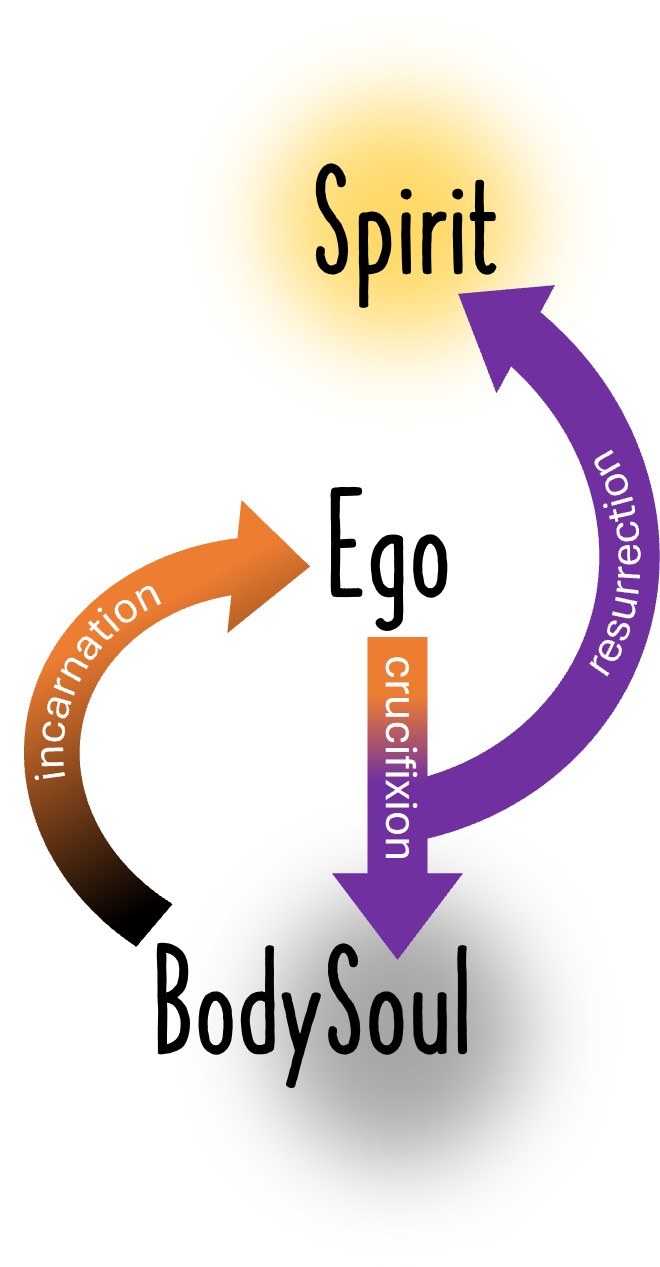
On one side are believers, who read the story of Jesus’ incarnation, crucifixion, and resurrection as an account of revealed journalism. Everything in the narrative happened just as described, to the exact detail.
How not? It’s the Bible, after all.
On the other side are atheists and the general population of nonbelievers, including devotees of other religions with their own stories and scriptures. The story of Jesus might be interesting and even inspiring to some extent, but that’s all it is.
What if the story of Jesus – specifically that three-part structure of incarnation (entering the human world by way of a virgin birth), crucifixion (giving up his life and dying on a cross), and resurrection (raised to new life and higher freedom) – isn’t an historical account or ‘just a story’?
What other choice is there? It either happened or it didn’t, right?
What if the story of Jesus didn’t originate with an itinerant teacher in the Galilee region of first-century Palestine? Not that it took its facts from some other historical figure, maybe in another part of the world, but that its truth is not about facts we can measure and record.
Could it be that the tripartite story of Jesus has had such magnetic power over people down through history and all around the world because it taps into something deeper than historical facts?
Fair warning to my reader:
We are stepping into the mythic realm here, where stories reveal and activate something essential in the human being, something archetypal and potentially transformative.
Rather than treat the story of Jesus as an analogy of things metaphysical, long ago, or far away, I will draw associations to the universal path of human development and our archetypal quest for the liberated life.
An archetype is a “first form” or generative pattern that drives and shapes our individual formation according to its exemplar. In this case, I am suggesting that we take the tripartite structure of Jesus’ story (incarnation | crucifixion | resurrection) as archetypal of our own human journey and potential transformation.
In the illustration above, the major aspects and dimensions of human consciousness are labeled. Starting at the bottom (in what the wisdom traditions name the Ground) we see the complementary dynamics of Body and Soul, written as “BodySoul” to remind us that our conventional way of dividing human nature into a body and a soul is historically late and a corruption of the originary insight.
BodySoul is the grounding mystery of our nature as human manifestations of being – as human beings. In us, consciousness is turned outward through Body to the larger web of life and, complementarily, inward through Soul to the deeper ground of being. It is from (or out of) our essential nature as BodySoul that each of us eventually takes our place in the world, as an Ego (Latin for “I”) playing roles on the social performance stage.
It’s important to understand that the modicum of consciousness channeled into the roles and tasks of managing a self-conscious personal identity neither originates with nor belongs to our Ego. It must draw current from the BodySoul in order to manage a meager circuit of its own, which it does by rehearsing the various scripts of identity that tell the story of “Who I am.”
In the archetypal language of myth, self-consciousness (Ego) is “born of a virgin,” which is to say it is not the product of two but a differentiation of One, of the prima materia or “First Mother” of BodySoul. The Christian concept of incarnation is very intentionally representing Jesus/Ego as arriving in the world by a kind of vertical entry rather than through the temporal chain of sexual reproduction.
We know from science that while the genetic traits of temperament are passed along from one generation to the next, Ego identity is not inherited but assumed (or “incarnated”) by the individual personality in the process of socialization.
The adventures of becoming somebody (i.e., an ego-centered identity) are infinitely amusing, but it can also be incredibly exhausting. Human beings didn’t evolve with the ultimate aim of personating roles and playacting on the social performance stage – notwithstanding the benefits of membership, recognition, and celebrity that might lock in our character and make us feel we have “made it.”
According to the worldwide spiritual wisdom traditions collectively known as Sophia Perennis, our true and higher aim is to become fully human, just as every other living species grows and develops toward its epigenetic Ideal of maturity and fulfillment (Aristotle’s entelechy).
Human consciousness – or we might better say, the evolution of consciousness in our human species – will not find fulfillment or be satisfied managing an identity on the social stage. No matter how lofty the role and how meaningful it makes our life seem, personal identity is still only somebody we are pretending to be.
There comes a time when something inside us turns our aspiration in a different direction: not out to the world, but inward to the grounding mystery of being.
As it plays out in the story of Jesus and is interpreted archetypally, crucifixion represents the surrender (as sacrifice, an act of devotion) of Ego to the BodySoul, of the personality to spirituality. In Christian terms, it is the historical Jesus dying into the eternal Christ. Medieval paintings (Pietàs) of the dead Jesus cradled in the arms of his mother Mary, still miraculously a virgin, poignantly render this deeper mythic meaning.
When consciousness is released from the roles, attachments, and distractions of managing a personal identity, it descends to awaken in the BodySoul. As the apostle Paul reflects in his letter to the churches in Galatia, “I have been crucified with Christ and I [ego] no longer live, but Christ lives in me.” Such an awakened present awareness is only possible to this degree after we have “died” to (i.e., detached and released from) the persona of our identity in the world.
In the gospel stories, Jesus speaks of the necessity for a seed to “die” so that the vegetal lifeforce of the plant can be unbound.
Likewise, it is necessary for the one who seeks authentic life to loosen their self-definition in order that the deeper truth of what they are can be set free.
“On the third day,” which is to say, after the surrender of Ego is complete, the newly activated spiritual intelligence rises with a fresh, expansive freedom. Resurrection, rising or being raised up, tracks the path of transformation from the BodySoul to Spirit. Whereas BodySoul is the grounding mystery of our being in deeper oneness, Spirit (from word origins meaning breath or wind) is dynamic, free-range, and communal, lifting awareness into the experience of higher wholeness and genuine community.
So you see, the story of Jesus is really about you. It’s your choice whether it comes true.
 Tracts of Revolution