In a recent post entitled The Vocational Clarity Table of Elements I made a case against a growing sentiment which regards a college education as a waste of time and money.
Of course, I had to preface my argument by first acknowledging the dismal statistics – 80% of college students change their major multiple times, 50% will not complete their program, and of the half that do make it, 75% end up finding jobs outside their degree.
I called that “the trap of going to college.” Colleges don’t help – because they don’t address the real problem – by implementing interventions and accommodations to keep students from dropping out. Students are still dropping out, and now colleges are burdened with funding all those ineffective failure preventions.
The real solution, I argued, lies in a change of paradigm, away from intervention and more intentionally toward a paradigm of empowerment.
While the mindset and methods of intervention are based on the assumption that students are deficient in what they need to be successful in school and life – and this paradigm governs Western education across all grades – the mindset and methods (i.e., the paradigm) of empowerment assumes otherwise.
Students already possess the potential, intelligence, curiosity and desire to learn; the work of education is to ignite this potential and “lead out” (ēducāre) each student’s natural curiosity into a deeper and wider understanding of themselves, of the world around them and their place in it.
Do students arrive to college confused, already depleted, bored with school, and emotionally disengaged? Yes, obviously. Is that because they are missing some key element that only a subject or service expert can provide? Interventionists say, Yes, our role is to keep students in their program – whatever the cost.
Proponents of empowerment – let’s call them education catalysts – recognize that the mental, cognitive, and emotional condition of these at-risk college students is itself a consequence of intervention and accommodation strategies from the early grades.
If the goal of intervention is to prevent failure and keep students in school, empowerment seeks to support and guide their progress in vocational clarity. Rather than trying to “fix the problem” (i.e., the high confusion, disengagement, and dropout rates), we will better serve college students by taking time to discover what they already have inside themselves, develop their individual intelligence, clarify their interests, and guide them (ēducāre) in exploring occupations that center the types of activity they enjoy and find interesting.
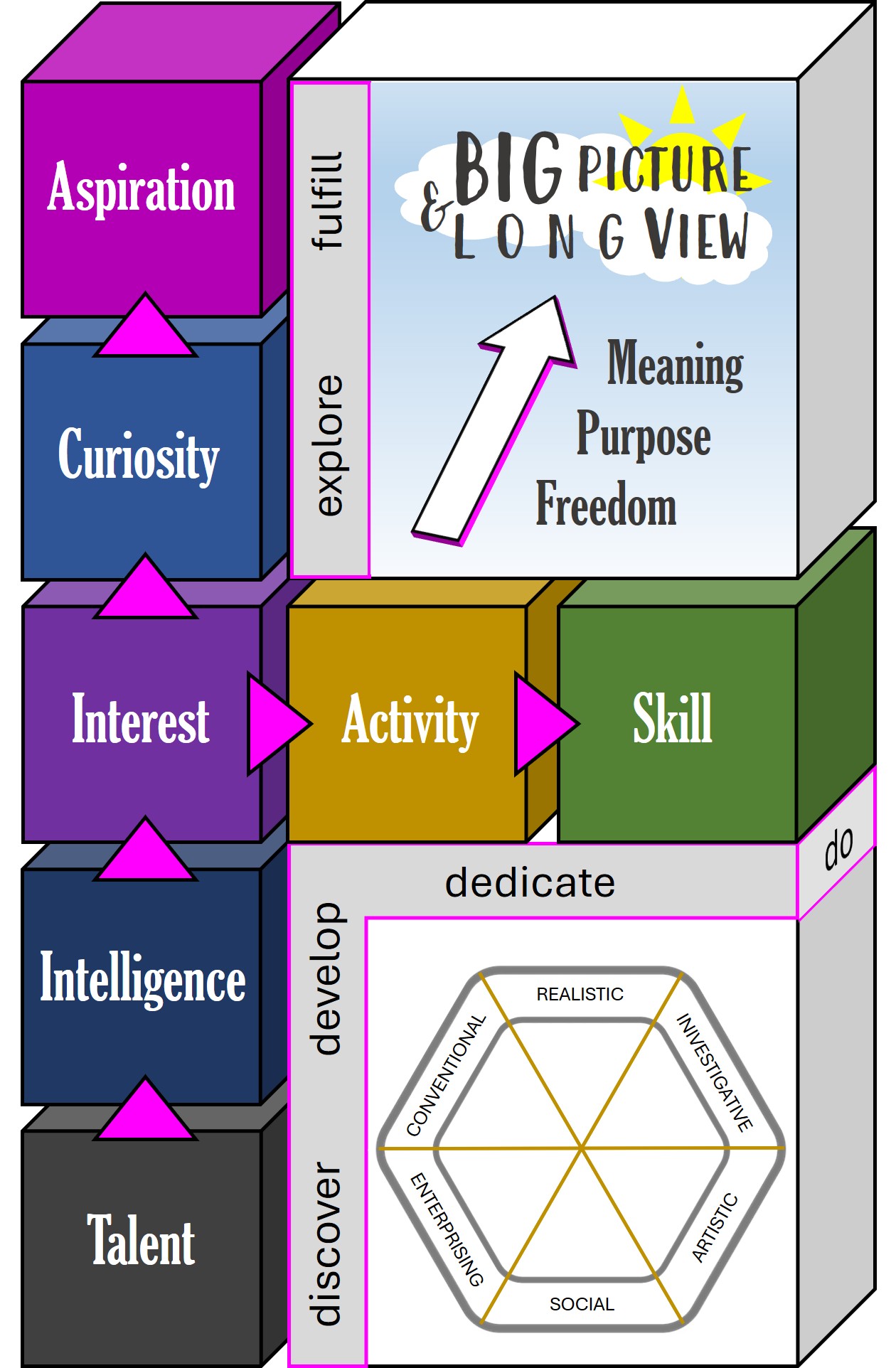
We would be wrong to conclude that a college education is only about getting graduates into jobs that align with their degrees, however. Vocational clarity is more than just having a clear path of purpose through college.
Even though the concept of vocation has been folded into other career-related terms like occupation and profession, its scope is much larger and reaches much farther. From the Latin vocāre, vocational clarity is about an individual’s “calling,” purpose, and direction in life.
Certainly, college and career fit into this bigger picture and longer view, but without a clear calling, purpose, and direction in life, students (like the rest of us) tend to fixate their expectations for fulfillment on jobs, status, and salaries – only to be disappointed.
In light of this, I have updated my Vocational Clarity Table of Elements to include an additional dimension of elements that directly addresses this quest of the student for fulfillment in life. That earlier model (now 1.0) placed John L. Holland’s concept of “interest” at the nexus of horizontal (outward) and vertical (inward) axes.
In Holland’s scheme, interest attaches (outwardly) to types of activity and the associated skills of work, as well as serving as a focusing lens (inwardly) of one’s deeper intelligence and talent.
In that earlier post I advocated for the empowerment paradigm of education, predicting that the statistics measuring student success will dramatically improve as colleges and universities intentionally (mindset) and strategically (methods) work to activate the potential students already have within themselves. Holland’s career theory and interest assessment have proven effective in helping individuals match their natural endowment (i.e., talent and intelligence) to occupations in the world of work.
The additional dimension of elements (2.0) returns to the nexus of interest, but now ascends the vertical axis to identify elements that engage students with the bigger picture and longer view of life. If interest serves as a focusing lens of intelligence – coming up from within, as it were – it also directs intelligence in the exploratory initiative of curiosity.
Developmentally, curiosity is most active in early childhood, losing much of its wide-open wonder in subsequent years as society shapes and fills (i.e., instructs) the mind with its cultural operating system.
But the creative, playful, and exploratory curiosity of childhood doesn’t have to be foreclosed under the regime of realistic and practical concerns – what many of us regard as adult life.
Curiosity projects the human spirit through the lens of interest along trajectories of aspiration that seek, or long for, fulfillment. There are five human aspirations: for peace (what I name our mystical aspiration), for love (our ethical aspiration), and three more that are centered in our vocational quest for freedom, purpose, and meaning.
My more complete model of vocational clarity – the Vocational Clarity Table of Elements 2.0 – identifies in human beings, and therefore in every college student, the longing for a chosen path of purpose that makes life meaningful.
Taking into account this higher element of aspiration, it becomes painfully obvious how an instructional system designed to fit students into standardized rubrics of knowledge and technique is actually working against their aspirations for freedom, purpose, and meaning.
Instead of clarity in their big picture and long view of life, student horizons are collapsing (being collapsed) around the trivial pursuits of grades, degrees, and jobs. Such things can be measured and managed, which explains why instruction has largely replaced education, since we can control what we put into (instruct) students and what they are required to recall on assessments.
But that spiritual longing? Those aspirations of the human spirit?
Who knows what could happen if educators embraced their vocational role as catalysts – igniting, activating, equipping, guiding, and then releasing the force that students already have within themselves?
No telling.
 Tracts of Revolution