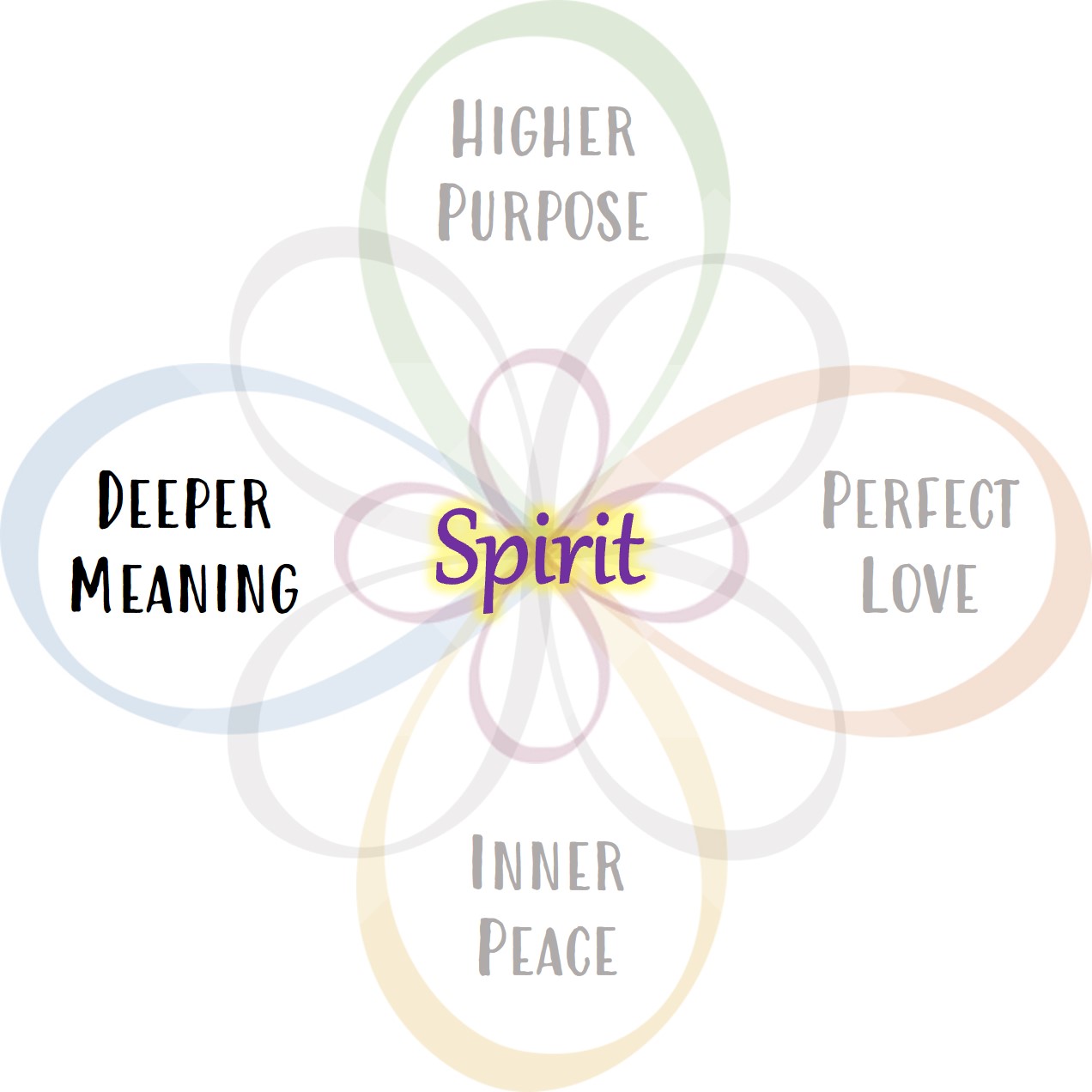
One of the deep and universal principles of spiritual wisdom states that the wellbeing and fulfillment we seek in life cannot, and will never, be found in this world. Many religions misunderstand this principle to mean that our salvation lies elsewhere or awaits us in the afterlife, in another world beyond this one.
Any interpretation that advises us to renounce the world and fix our devotion on supernatural, heavenly, or otherworldly things is a contradiction of wisdom’s vision. Tragically, although most religions originated in this vision and its profound insights into the nature of Reality and our human promise, too many of them, and too soon, lost its compass and got distracted from the path into deathtraps of dogmatism, conviction, and power politics.
The grand vision of the spiritual wisdom tradition, better known as the Perennial Philosophy or Sophia Perennis, honors the human spirit in each of us as a force of creative freedom that seeks, desires, and drives our quest for wellbeing and fulfillment. This quest is frequently frustrated by the lesser ambitions of our ego, the unique and separate “I” who is busy being somebody special and chasing after happiness.
Spiritual wisdom invites and challenges us neither to renounce nor glorify the ego, but to part its veil of illusion and see things as they really are.
The Path to Deeper Meaning
Like being, “meaning” (as we will be using it here) is a gerund word-form that got its start in reference to an action or process “carried on” (the literally definition of gerund). The -ing gives it away, in this case, and calls into question our usual habit of regarding meaning (as well as being) as a noun, a peculiar kind of object that we might catch in a net and tack to our pinboard.
If meaning is not an object, then what sense is there in searching for it? As if we might dig it up and drop it into our travel bag for a more meaningful life. “Man’s Search for Meaning” (V. Frankl) is a popular trope; everyone wants it and can’t seem to get enough.
The idea that meaning is something out there just waiting to be found likely has its roots in religion.
As god’s creation (so goes the myth), the whole cosmos appeared out of a divine intention and now stands before us as a work of art, imbued with meaning, as it were. For many religious believers, the universe is meaningful because god meant for it to exist. The created order is a product of god’s design and everything in it has a place, a purpose, and a meaning.
Meaning is out there and all around us; we just need to find it.
With the rise of science, this religious sensibility came under suspicion. Setting aside the tendency in theistic religion toward fanatical forms of devotion, its dogmatic insistence on the literal existence of god – arising historically as a self-defensive reaction to the methodological skepticism of science and the spread of a secular worldview – has had the effect of pushing underground the more essential concerns of faith, spirituality, and the nurturing of human aspirations.
Scientific skepticism (skeptos refers to what can be seen, touched, or at least measured) does not find meaning in the universe, certainly not as an inherent value added by a god whose existence is unsupported by the evidence or required in theory.
Inside and underneath consciousness are organic processes of the lifeforce; inside and underneath the lifeforce are electrochemical, elementary, and quantum forces – but no meaning.
It just doesn’t show up. For this reason, meaning is neither a substantial property nor a natural feature – certainly not a supernatural feature – of the universe.
In the last 150 years or so, Western philosophy and psychology have developed on the discovery that meaning, in the form of ideas, values, beliefs, ideologies, and worldviews, is a human construction. Known as constructivism, this theoretical approach now informs everything from advertising and marketing, to religion and politics, to intercultural learning and community organizing, to mental health therapy and social influencing.
The constructed nature of meaning shines new light on our human susceptibility to superstition, so-called “alternative facts,” brainwashing, conspiracy thinking, and truth distortions in the social media echo chamber.
If meaning is something we just “make up” (literally construct), and if god is no longer in the picture as supreme arbitrator of what’s true or false, then those with the largest networks and strongest amplifiers will decide what the masses believe.
For millenniums now, the spiritual wisdom tradition of Sophia Perennis has propounded on the insight that meaning is in our minds and not in Reality. The vast and enveloping system of worldviews, mythologies, knowledge and beliefs – including those mythological gods and even scientific knowledge – is a massive projection out of the human mind.
As compared to the present mystery of Reality, it is all an illusion; and to the degree we take it for Reality, a delusion.
The instant we put a name on something and give it a definition; tell a story or conceive a theory to explain it; grasp it with our mental concepts and file it away in the archives of knowledge – in that very first instant, our mind drapes the Mystery with a veil of meaning. Indeed, with each step we are adding more veils and more layers of meaning between our mind and Reality.
This can go on until the drapery of meaning becomes so dense and opaque, that the Light of The Real no longer gets through.
It is our ego’s need for security, identity, recognition and belonging that drives us farther behind these veils of meaning. The insecurity of standing apart from the body (psychologically speaking) and alone in the middle of Everything makes of meaning a comforting illusion. Having lost sight of The Real, we grow increasingly vulnerable to broken logic and gullible to baseless claims. Before long, we are so far into delusion that we’re ready to believe anything.
The human spirit cannot live in delusion, however, and it regards the illusion of meaning as something to be penetrated and swept aside in the interest of touching Reality.
Deeper meaning is not more meaning; indeed, more meaning only has the effect of further separating our mind from the present mystery of Reality. According to Sophia Perennis, we have a choice between more Reality or more meaning.
The seduction of meaning is obvious. On the other hand, a relentless pursuit of Reality leads to self-authenticity, personal honesty, social credibility, vocational clarity, and creative freedom.
Our longing for deeper meaning in life compels us to always look through meaning to the present mystery of Reality; and if our veils are blocking the Light, to take them down or push them aside for the sake of seeing and touching the really real for the first time once again.
Reality is ineffably perfect and perfectly meaningless – just as It is.
Other Posts in This Series:
 Tracts of Revolution
3 thoughts on “Our Longing for Deeper Meaning”