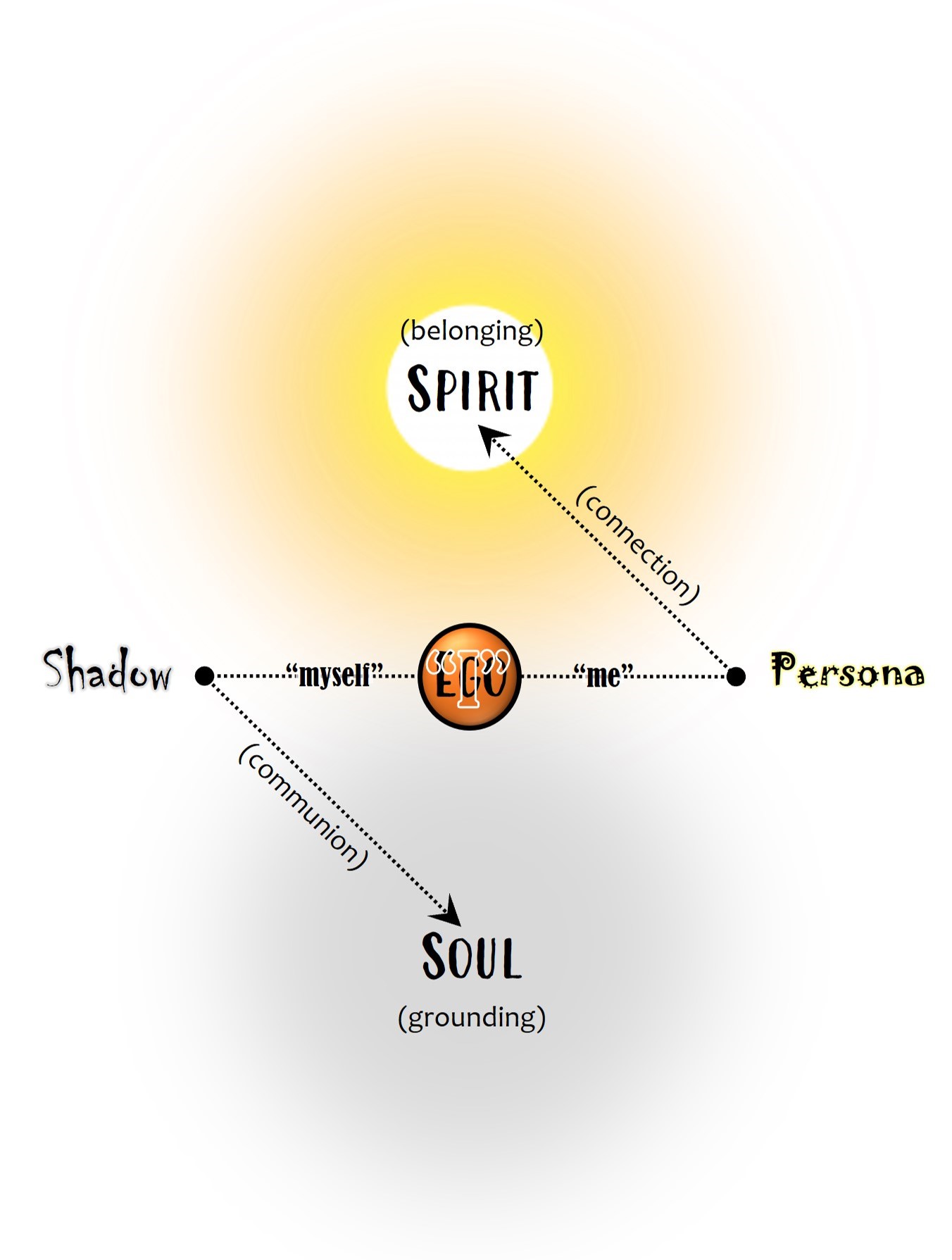
We live in an “age of identity.” We’ve been in it for a while now, beginning way back before historical records even. In other words, it’s not just a “modern” thing. The Age of Identity began with the breakthrough to a self-conscious experience, when the last hominids poked their heads above the threshold of a body-bound consciousness, blinked their eyes and realized they were naked, therewith becoming the first humans.
Our species is pretty much obsessed with personal identity: turning over (and over) the question, “Who am I?”
At the core of this obsession is ego – the self-conscious “I” that sits above the body and apart from everything else, a what seeking its who. Ego’s emancipation from a purely sentient-instinctual life is facilitated by a tribe of “whos” that collaborate in shaping this naked newcomer into “one of us,” a properly well-behaved member of civil society.
By a combination of blocking, coaxing, training, modeling and instruction, a proto-person is gradually transformed into a full person. Our word ‘person’ comes from the Greek prósōpa and Latin persōna, referring to the character masks that actors wore in playing roles on the performance stage. “Speaking through” the mask, a performer personifies a character from myth, legend, history, current events or pure fiction, bringing it to life, as it were, across the changing theatrical scenes.
In the context of a play, an actor is pretending to be (“playing”) the character.
A persona is merely the role that ego (the actor) puts on in the interest of stepping into and joining a role-play. A major difference, however, between the stage actor and an ego in everyday life is that, whereas the stage actor takes off the mask and steps out of the role when the performance is over, an ego that has been fully personated by the tribe is now completely under the spell of identity and honestly believes “I am” what it has been pretending to be.
The attraction and instrumental value of a persona lies in its function as a point of entry, a placeholder, a mode of status and reciprocity in the interpersonal realm of social relationships. It confers on the performer a certain degree of recognition, acceptance, approval and respect – what we might call the social benefits of personal identity.
An otherwise naked and exposed self-conscious ego is now clothed, connected, and identified as somebody special.
Lest we make the mistake of attributing identity to the ego itself, it’s critically important to see that on its own and all by itself, ego is nothing more than naked self-conscious awareness. Identity is found and curated through personas and the characters they equip ego to play on the social performance stage. Without personas and off stage, “I” (ego) am, quite literally, nobody but an actor looking for work in a role-play that will define who “I” am.
An interview with the actor will reveal that ego does indeed have some sense of itself off stage, but this happens to be more of a shadow than a legitimate identity. When it reflects and dares to contemplate this subjective side of “myself,” what is hiding or concealed there are aspects of the embodied personality that didn’t get invited to the stage, were cautioned against showing up in the early years, or were systematically repressed for violating the tribe’s moral frame.
Just as the persona of identity is the “me” ego wants others to see, its shadow collects the parts of “myself” that “I” had to throw behind the closet door and effectively disown in order to fit in, find acceptance, and be somebody special in the eyes of others.
The shadow, with its forbidden, disowned, and forgotten “light,” shows up in mythology under the guise of the Adversary (“Satan”) and the Light-bearer (“Lucifer”), characters who work in opposition to (the ego’s) god or as god’s “left hand.”
Psychosomatically the shadow hides in symptoms of autoimmunity, neurasthenia (the “nervous exhaustion” of bipolar anxiety-depression), and borderline personality disorders that swamp and threaten to reclaim the ego from below. Psychosocially the shadow gets projected onto others (individuals and groups) who are consequently judged and persecuted (or dutifully avoided) as dangerous, “bestial,” and evil.
In proportion to the degree that social approval necessitates self-denial, the shadow of identity grows that much darker and formidable. Ego’s “myself” is despised and debased. leading to a point where some combination of introjected shame and outward-projected hostility becomes the word and will of god. From then on the game is locked. Salvation is redefined from a process of being healed and made whole, to a final escape from the body and this sinful world.
It should be obvious that our meditation so far has been concerned with the so-called ‘conventional’ world, where the emergence of a self-conscious experience and the shaping of personal identity on the social stage have conditioned just about everything a person fears, cares about, and pursues in life.
Conventions are the common codes, mutual agreements, shared beliefs, and collective habits that define a world. A self-conscious personal identity, playing out to the stage through personas and pushing into the shadow whatever doesn’t fit the moral frame, knows only this world – but not Reality (aka ‘the real world’).
In the meantime, our deeper human needs for communion and grounding, along with our higher needs for connection and belonging, are neglected.
More accurately, these deeper and higher human needs are intentionally ignored, since fulfilling them would require waking up from the spell and parting the veil on this social illusion of personal identity and its conventional world. Which is why ego’s religion and its god work so diligently to preserve the trance and keep everything (read: everyone) in its place.
This is where wisdom spirituality, by its descending-mystical and ascending-ethical paths, threatens the world order.
Wisdom calls on the self-conscious ego to drop (metaphorically “to die”) into the deeper oneness of being-itself (communion and grounding), and to transcend (“go beyond”) the conventional ‘good and evil’ of tribal morality for the higher wholeness of genuine community, with its inclusive ethic of compassion, fellowship, generosity and goodwill (connection and belonging).
The guilty conscience which had been effective in keeping ego in its proper place is now willingly, passionately, exchanged for conscientious guilt over breaking the moral code wherever it happens to be oppressing the Human Spirit and keeping anyone from the fully awakened and liberated life.
 Tracts of Revolution