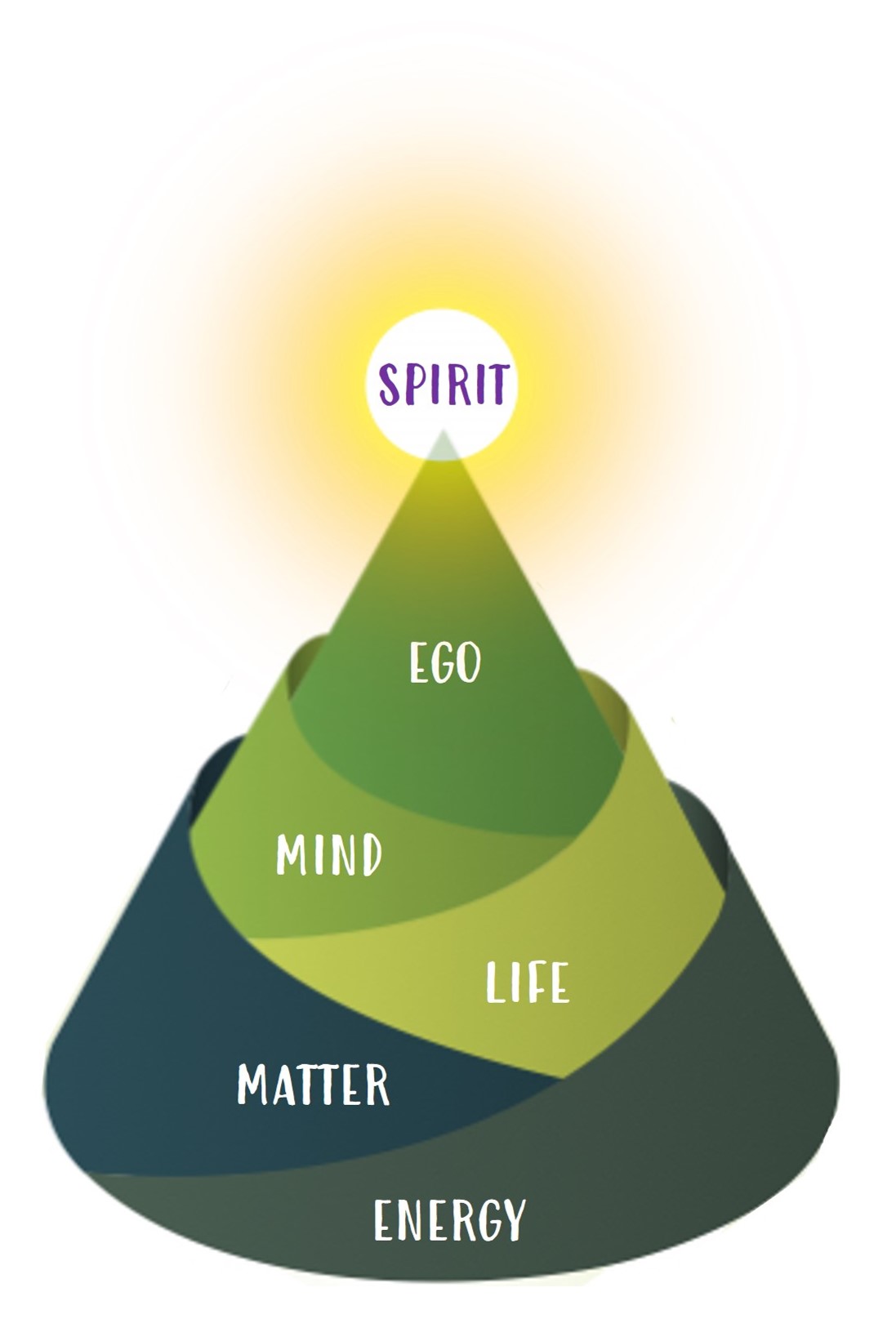
The illustration above captures in a single image a grand view of the Whole Shebang. It is the dialogical product of our two traditionally complementary systems, science and spirituality.
Unfortunately, the metasystem of religion which historically served to hold these two in coordinated balance and mutual support, made the fateful mistake of defending a literal reading of its myths against what it regarded as threats from both sides.
Scientific observers and empiricists were making discoveries that would eventually replace the three-layered cosmos of earlier times with an expanding universe of unimaginable dimensions. At the same time, spiritual contemplatives and mystics were exploring new depths of the inner life and finding there a grounding mystery more present and real than the gods themselves.
In its defense, religious clerics and scholars began locking religion down to an orthodoxy and liturgy that effectively closed off external Reality and the inner Ground from believers. The consequence was a centuries-long “dark age” as science and spirituality continued on their paths to enlightenment and liberation, but religion succumbed to intellectual hypoxia (starved of fresh air) and spiritual sclerosis (becoming rigid and dysfunctional).
Today, with conventional religion on a dramatic decline in membership and attendance, we are seeing a renewed dialogue between science and spirituality. The modern veering-away of science into reductionist materialism and of spirituality into esoteric metaphysics, absent the counterbalancing support and correction that healthy religion might have provided, has resulted in decreasing enrollments on both sides as well.
A new type of religion is now gaining a worldwide following, one that is Earth-based, life-centered, human-focused, and community-oriented. This religion – and the term is justified in recognition of its conscious intention of “linking back” or connecting (Latin religare) us to one another, each of us to our inner Ground, and the community to our home planet – doesn’t have a priesthood, a ritual system, an institutional structure, or even a credo.
This religion can even flourish in traditions that have not cut themselves off from science or spirituality, that embrace their role in nurturing a faith which can finally see through and beyond its preferred concepts of God.
It is therefore, and by definition, ‘post-theistic’.
A grand view of the whole shebang, as illustrated above, is the dialogical product of science and spirituality, finally rescued from their respective quagmires of reductionist and metaphysical distraction, reconciled at last in a contemporary post-theistic paradigm.
The cone image also has the semblance of a mountain, with various ridges having formed in its upward thrust to an illuminated peak. This idea of ‘formation’ nicely captures the spatial and temporal dimensions we need in order to appreciate the universe as not merely the product of cosmic events but as an ongoing evolution in time, a single-turning event of the largest scale (uni-verse).
The bottom regions of the cone, or cosmic mountain, represent the earliest events and deepest forces in the universe. A primordial “flaring-forth” (big bang) of quantum energy began the process of crystallization which produced the basic structures of matter. As the material realm expanded and cooled, these elements combined into new molecular configurations and further condensed into the compounds of planets with their local environments and atmospheres.
On our own planet of Earth, material conditions gave rise to organic properties and gradually to organisms with the capability of capturing, converting, and storing energy for their own special use. Soon – over many millions of years! – organisms would develop powers to restore, repair, reproduce and replace themselves with new generations of life.
As these primitive forms of life connected in symbiotic networks for resources and protection, the emerging webs of differentiation shifted the living realm into higher, more complex systems, creating the need and capacity for self-regulation, sensorimotor intelligence, and ambient awareness – thus giving rise to the realm of mind (i.e., sentient life).
Countless species of plant and animal life multiplied and filled the earth.
In one particular animal species, our own human lineage, mind further differentiated for the work of regulating the interior body, reacting and adapting to its environment, and orienting the individual inside its own projected dome of concerns, preferences, values, and meaning.
To effectively get around and flourish inside this world-projection, the individual required a center of personal identity and affiliation that could keep it connected to the tribe. The external monitoring, guidance, and motivation provided by the group was gradually transferred inside the individual and established as the ego (Latin for “I”) of a personality, referring to a collection of “masks” (personas) and roles it uses to engage in the various role-plays and interpersonal transactions of social life.
This activation of a subjective center for self-monitoring, self-guidance, and self-motivation gave rise to a game-changing but chronically tormented mode of self-conscious experience.
Ego formation brought our human journey into the steep and treacherous mindscape of profound insecurities, neurotic disorders, self-destructive behaviors, conflicting beliefs and worldviews, spiraling self-obsession, as well as debilitating cycles of anxiety and depression.
We are starting to understand that, just as the principles of differentiation, individuation, and participation in the earlier stages and deeper regions of the cosmic mountain conspire(d) to create conditions for the emergence of higher complexity, so is our self-conscious ego and personal identity (i.e., our individuated self) just the precursor to a transpersonal leap of participation in something higher still.
In the past, this is where science would shake its head and walk out on the dialogue with spirituality. It’s important to note once again, however, that it was the mythological literalism of a religion which refused to evolve, that turned the metaphor of breath or wind (Latin spiritus: spirit) into an independent divine being, rather than a word-image for the dynamic flow of creative freedom and genuine love between and among self-transcending egos.
Spirit is a communal metaphor of connectedness, reciprocity, fellowship, solidarity, and inclusion.
It is community.
It is tempting to see spirit as always and already deepest within the cosmic mountain, just waiting for its time to emerge. Science can’t go along with that, and for good reason: Spirit isn’t some thing, but rather the participative unity of individual egos in transpersonal fellowship. We can observe it scientifically and even measure its effects, but we will never isolate it in a laboratory or find it wandering about on its own.
To say that …
- energy “gave rise” to matter, or that matter “emerged” from energy;
- matter “gave rise” to life, or that life “emerged” from matter;
- life “gave rise” to mind, or that mind “emerged” from life;
- mind “gave rise” to ego, or that ego “emerged” from mind;
- ego “gave rise” to spirit, or that spirit “emerged” from ego (or better, that it emerged from the transpersonal fellowship of egos)
… in each case we are referencing conditions which are favorable and conducive in generating a synergy that “bumps” things into a higher order of complexity and creative transformation.
What we bring individually to the spiritual phenomenon of community is a grounded faith, a centered presence, a welcoming attitude, a compassionate interest and unconditional generosity.
We draw from the wellspring of soul within and give ourselves to the dance, to the work of forming an ever more perfect union.
 Tracts of Revolution