I’ve been interested in human nature, psychology, and development for a long time. My preference is to consider each of these through the lens of evolution, asking all along what a fully evolved and self-actualized human looks like. Most posts in this blog on creative change come at this question from one angle or another.
In this post I offer a simple, but hopefully not oversimplified, conceptual model for understanding our human adventure into maturity and fulfillment.
To make it interesting, I’ll use you as our human subject. Let’s get started.
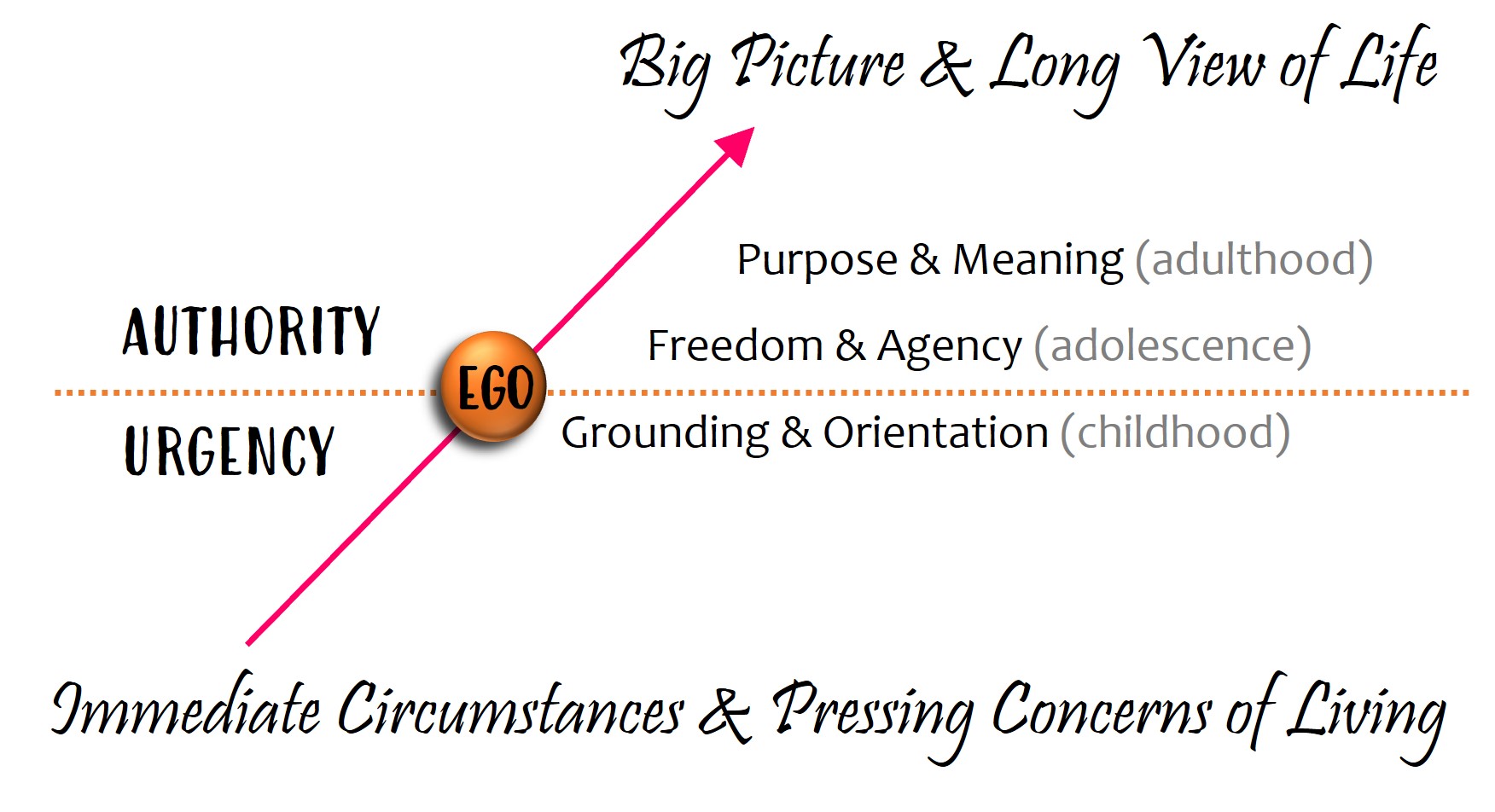
You have a lower, primal, or first nature in an animal body that is fully immersed in what I will call the zone of urgency. This zone includes your immediate circumstances, what’s constantly going on around you, and also the pressing concerns that impinge on your experience one moment to the next.
To qualify this zone as one of “urgency” merely acknowledges the fact that consciousness at this level is fully dedicated to keeping you alive.
Given everything that must be regulated, coordinated, and negotiated in just keeping you alive, there’s a lot going on in this zone of urgency. So much, in fact, that it can demand almost your entire bandwidth of attention and energy.
If you happen to be prone to anxiety, the immediate circumstances and pressing concerns of living can at times be overwhelming. Not only is so much going on, but so much can go wrong that you have an impossible time getting a grip on it all.
All of those stressors (external factors, many beyond your control) trigger your nervous system into distress, where a bunch more things can go wrong.
The thing about anxiety and worry is that there is no end to it. There’s always something else, or something more adding to what you are already fretting over. Because your nervous system and energy reservoir are limited in their capacity, eventually all this tension drains your supply and dumps you into a state of nervous exhaustion.
When this nervous exhaustion pulls your mind down into it as well, you can be diagnosed as suffering from depression (literally the feeling-state of being “pressed down”). Maybe you don’t get diagnosed with clinical depression but are among the many millions of humans who have discovered that even a broken night of sleep can be just enough (though barely) to replenish your energy reservoir for another day of unproductive worry.
As I said, there are many, many people today who give just about everything they have to the work of barely managing their unhappiness from day to day. Sure, there are occasional thrills, passing pleasures, and maybe weekend bouts of intoxication, but the general tone of experience in this zone of urgency is fairly dark and gloomy.
Prescription meds might lift the shade a little, but these also invite other complications – and more things to get anxious over.
Let’s be clear. The vast majority of other animal species on Earth also live in the zone of urgency, navigating and reacting to their immediate circumstances, motivated by their pressing concerns of living. Staying alive, seeking safety, finding mates, rearing young, acquiring what they need to … stay alive – such are the preoccupations of this zone.
A major difference between them and you lies in your tendency to get locked up in anxiety and depression.
Actually, this tendency of yours is a sign of your capacity for something more. That debilitating cycle of anxiety and depression is what predictably happens when you either forget or fail to discover the power in yourself which we call the human spirit.
As a human being, you are (we might say) destined by your higher nature to seek after more than merely surviving the day. And because you have this power in you, this irrepressible longing and aspiration, any coping strategy you might use to manage living in the zone of urgency will only add frustration and duration to your suffering.
Ultimately, your higher nature desires a big picture and long view of life that makes it worth living. I call this the zone of authority because a life worth living is really a product of your creative storytelling. And in this important sense your authority is about authorship, engaging your authorial power as a human being to clarify your purpose and compose the meaning of your life.
Life in the zone of authority is very much, then, both a symptom and expression of the human spirit in you.
A big picture and long view provides the narrative context and motivational lens for a liberated, more enjoyable life. That term, “liberated,” is especially significant here, in the way it sets the contrast between the lower zone of urgency and this upper zone of authority.
Down there you have very little freedom, but are instead compelled by urgency to react, which then forces you into another pinch-point where you have to react again (and so on). You may try to avoid or procrastinate on something and feel a bit of momentary relief, but the urgency will be back very soon – with extra hammers and hooks.
Many people don’t have a reference point for understanding the kind of liberation they might enjoy in the zone of authority. For the longest time, humans imagined this kind of life through the gods of mythology – fictional projections, really, of their own aspirations for purpose and meaning, of the longing for a “god’s-eye” view on life and the liberty to live as they might choose.
Your own ascending path from the zone of urgency to the zone of authority follows (or has followed) a few predictable stages of developmental achievement. In the diagram above these stages are associated with the major eras of childhood (birth to age 10) and adulthood (beginning around age 25 after the brain’s higher centers are fully online), with the transitional phase of adolescence (“becoming adult”) in between (roughly age 11 to the early twenties).
In order to one day enjoy life in the zone of authority, you first needed your parents and other taller powers to satisfy your existential need for grounding and orientation. Such a foundational assurance and inner release to a provident Reality is the true meaning of faith.
Faith is what gradually enables your calm and centered presence amidst the immediate circumstances and pressing concerns of living (zone of urgency).
Only with this deep faith that you are okay, that Reality has your back and provides what you need most right now, can you find freedom from anxiety and break the chain of reaction that has held you back for so long.
During the developmental phase of adolescence you further centered this freedom within yourself and began to take control – not over everything going on around you, but of your own words and actions, your thoughts and feelings, even to some extent your wants and needs.
This centered sense of control, freedom, autonomy, initiative, and responsibility is known as agency. It is one of the telltale signs of successful “adulting.”
Now, with this freedom and agency you could further develop, refine, and extend your creative authority. Remember, the big picture and long view of life is largely yours to design.
For thousands of years, especially before it got taken up and absorbed into the various disciplines of modern science, philosophy – literally the “love of wisdom” – provided emerging adults with questions, proverbs, parables, principles and practical advice for keeping their stories aligned with Reality (i.e., truthful) and conducive to human (both personal and communal) wellbeing.
As you can see, none of this is really new. And yet, as you take this opportunity to clarify your purpose and create a meaningful life, in a real sense your whole world begins again.
 Tracts of Revolution
One thought on “Author of Meaning”