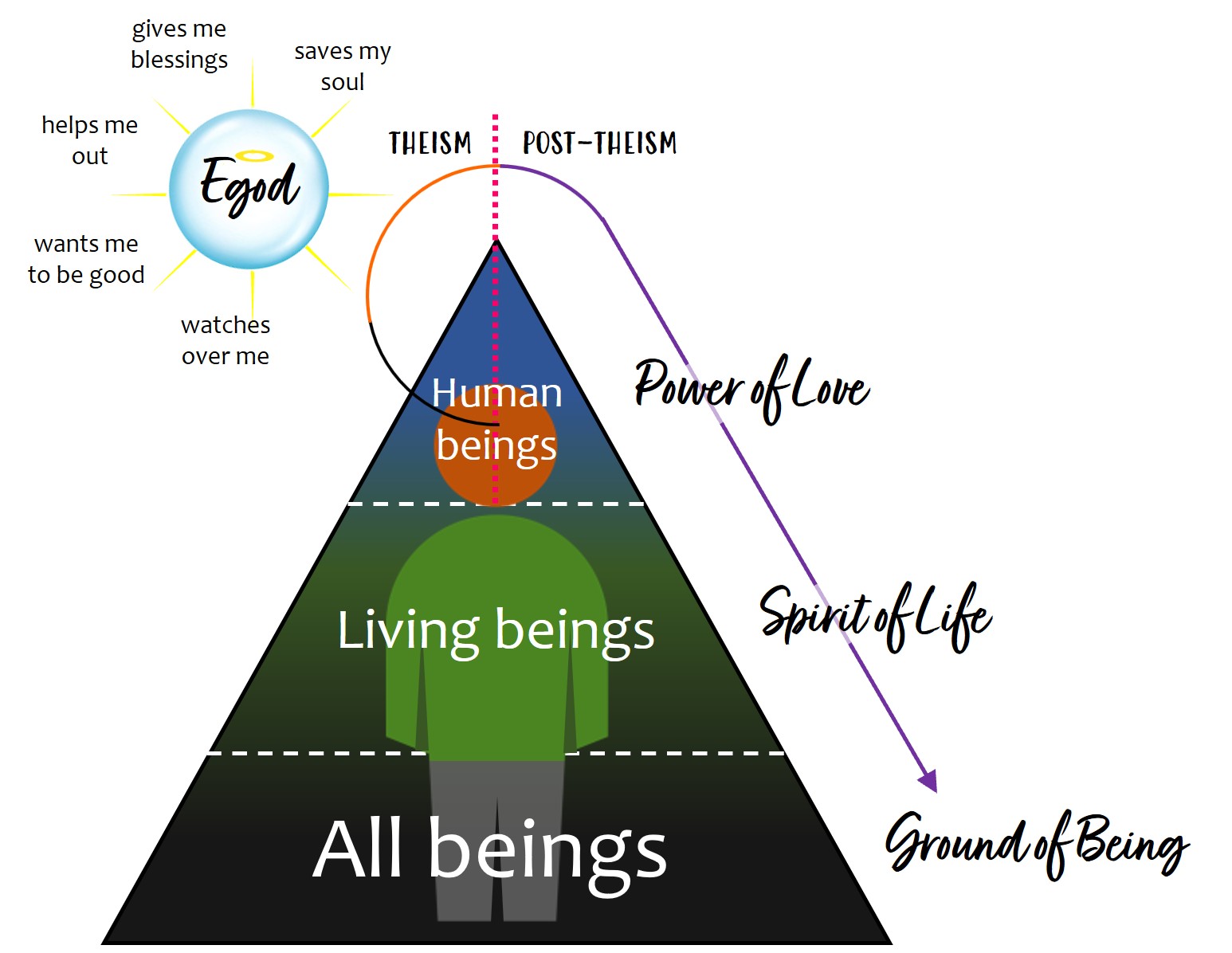
If you believe in a god who loves you, perhaps in a “heavenly Father” who is loving, gracious, compassionate, and merciful, a divine or supernatural personality who is happy with your obedience but gets angry or disappointed when you mess up or fall short, what you likely have there is not God but an idol, at the very least a human construct.
An idol is any human artifact – be it a fictional character, artistic image, theological concept, or just this free-floating idea of god in your mind – which is regarded as a literal or factual depiction of God.
Now, this gets a little tricky, so let’s be careful here.
What makes this human construct an idol is not merely the presumption behind it, that a character of myth, for instance, has this temperament or that disposition. The human imagination is a “factory of idols,” as the Reformer John Calvin insisted, not because it conjures up images and uses these to entertain itself and represent Reality, but because it so easily misappropriates its own constructs (god) for the mystery (God) it is contemplating or presuming to talk about.
Just that quickly, God as Ground of Being, Spirit of Life, and Power of Love is reduced to a separate being who lives somewhere out there and (hopefully, at least for now) loves you. A depiction or concept eclipses and takes the place of an ineffable Mystery and in the process becomes an idol.
Because no idol can encompass or adequately represent what is essentially beyond representation, your fervent devotion, dogmatic defense, and evangelistic witness on behalf of this idol of yours agitates something deep inside you – a growing insecurity and rising doubts over the likelihood that you just might be holding onto something that isn’t God and not real after all.
But now you can’t let go. You’ve invested too much and renounced so much more in service to your idol. Psychologically what happens next is that your inner insecurity and well-grounded doubts get amplified by the desperation you feel over attaching yourself to a counterfeit, to something that isn’t ultimately real.
Robertson Davies helped us unpack the inner workings of religious fundamentalism (or fundamentalism of any kind) with his observation that “fanaticism is overcompensation for doubt.” The aggression and violence of a religious fundamentalist are his attempt to stifle the realization that he is mistaken by intimidating or, if need be, even eliminating those who challenge his convictions.
Simply not agreeing with the convictions of a fundamentalist will be taken by him as a challenge and threat, poking at his deeper insecurity and suppressed doubts.
The theory of religion advanced in this blog identifies three major stages or types in its longer evolution through human history. These stages or types translate to the level of individual development as distinct paradigms of faith: a body-centered faith (animism), an ego-centered faith (theism), and a soul-centered faith (post-theism).
In more traditional societies where the norms, customs, and rituals of shared life are faithfully conserved from one generation to the next, the initiation of children into a theistic worldview is facilitated by a coordinated mythology of stories that represent God (Love, Life, Being) in personified form (god) – as in the example of a “heavenly Father” in Judeo-Christian theism.
Such metaphorical representations are neither embraced nor scrutinized by children for their factual accuracy. The psychology of a child hasn’t yet developed to the point where a dividing line between fact and fantasy (or fiction) is established. They simply listen to the story in rapt attention and imaginatively engage with its settings, characters, actions, and events. The story “does its work” on them.
For a child, the god depicted in sacred stories is not an idol but the Mystery of Love, Life, and Being represented in personal form. Again, they are not yet capable of distinguishing between the presentation (god) and what it represents (Mystery/God). With their “mythic-literal” faith orientation (James Fowler), the stories are simply taken at face value (i.e., literally) and the characters come to life in their creative imagination.
The Power of Love is personified in the god, gradually clarified in the cycle of sacred stories*, and finally perfected in the child’s imagination to become a creative force in his or her own character and attitude toward the world.
There is no factual realm outside the story as yet, which will later on force a distinction between what’s inside the story and what’s real, what really was or is outside the story.
A healthy theism supports and facilitates the successful formation of self-conscious identity (ego) in children by orienting their imaginations and developing their personal character on the “Super Ego” of god. They are assured of god’s presence, protection, providence and love, which instills in them a profound trust (faith) in Reality as benign and responsive to their needs. A tribe’s patron deity is presented to children as someone who cares for them and wants them to be caring, good, and kind in turn.
In Egod and the Future of Faith I coined the term “Egod” to label this reciprocal dynamic of ego-as-god’s-reflection and god-as-ego’s-projection. While this dynamic easily can, and often does, spin off in pathological directions, it is basic to the formation of faith in children.
Damage occurs when the managers of theism – parents, priests, pastors and teachers – impose their own undeveloped, deformed, and diabolical concepts of god on the new generation.
In later development, when they have acquired the intellectual capacity for distinguishing between fantasy and fact, between the god in stories and the Mystery of God (or the present mystery of Reality), adolescents are ready to look through the stories like embroidered veils or cathedral stained-glass windows, to the light-source beyond.
Healthy theism will encourage this reappropriation of myth as metaphor by affirming the poetic and artistic (i.e., constructed) origins of its god: This is how we represent the Mystery among us (Love), all around us (Life), and deep within ourselves (Being). It’s just a picture, a way of thinking and talking about what is beyond thoughts and words.
When I earlier suspected you of idolatry, dear reader, I assumed you had either grown up inside an unhealthy form of theism that motivated you by guilt to lock down on one concept of god or another; or perhaps you came to theism later in life and took its metaphorical depictions literally – not in the naïve mythic-literal manner of a child, but as eye-witness accounts of supernatural realities and miraculous events, according to the dictates of dogmatic orthodoxy.
And now you’re stuck with them.
But maybe that’s not true. Perhaps you do have an appreciation for the mythopoetic imagination and the metaphorical nature of religious “god-talk.” Whether your faith was shaped inside a Christian, Moslem, Sikh, Jewish, Hindu, Buddhist, Pagan or some other theistic tradition, today you can see through the veil to the light-source beyond.
You celebrate the Power of Love that draws human beings into communities of compassion and goodwill. You honor the Spirit of Life that animates and pulses across the great Web of living beings. And you contemplate the Ground of Being deep within yourself, where ego consciousness and the concerns of identity unravel, dissolving into a quiet and profound sense of inner peace.
Love, Life, and Being: God for everyone.
 Tracts of Revolution